Download
1 / 33
330 likes | 451 Vues
This paper investigates the physical aspects and energetic considerations of photobioreactors (PBRs) for algae cultivation, highlighting their role in CO2 fixation and photosynthesis on an industrial scale. It presents the challenges limiting the efficiency of PBRs, including lighting technology, control systems, and harvesting techniques. Analyzing diverse algal species, the study examines energetic yields from sunlight, the impact of light as a limiting factor, and potential applications such as biofuels and biomass production. It also explores the future of sustainable agriculture and climate solutions using algae.

E N D
Institut Angewandte Physik Fakultät für Physik Universität Duisburg-Essen, Campus Duisburg AG Prof. Dr. H. Franke
Contents • motivation: the CO2-problem • photosynthesis on an industrial level? • Requirements for PBR`s with algae • Energetic aspects • Algae,(some 10.000 species)examples • Suspension with 3 phases: gas,cells,EPS • Light as a limiting factor • Electric properties • Achieved applications
1Keeling_Kurve Gipfel des MaunaLoa Sägezahn zeigt Jahreszeitliche Schwankungen
CO2 • CO2 ist ein Klima-Gas (Treibhauseffekt) - fossile Brennstoffe: • C + O2 CO2 + Δ W (ca. 20 MJ/kg) • IR-Spektrum: • Rückführung in C- Kreislauf
2 .Die Photosynthese: Reaktionsgleichung h·ν 6CO2 + 6H2O C6H12O6 + 6O2 Lichtreaktion Lichtreaktion Dunkelreaktion Dunkelreaktion
Photosynthese in industr. Maßstab?: PBR • PBRs dienen der CO2 Fixierung • Derzeitig drei Probleme welche die Effizienz begrenzen: • Die Beleuchtungstechnik • Die Regelungstechnik • Die Erntetechnik
Weitere Argumente für kompakte PBR´s • Welternährung: die landgestützte Pflanzenproduktion kann in Zukunft Die Welternährung nicht mehr leisten • Fläche: gesamte nutzbare Fläche • Wasser: Algen benötigen weniger als…
Vorbild :Cyanobakterien im Carbon:Fossile Brennstoffe • Alle vorhandenen fossilen Brennstoffe stammen aus Photosynthese: => aus vorhandener O2-Menge folgt: 4x 10¹⁴ t C auf der Erde vorhanden • davon bis 1992 gefunden: 10.4x10¹²t SKE • (nach Würfel:“Physik der Solarzellen“,SpektrumAkad. Verlag, Heidelberg, 1995)
4. Photo-Bioreaktoren • Rohstoffe + Licht • Traditionell: Freiland, Teiche • Labor: Röhren=> LED´s - zur Produktion spezieller Stämme - zur Erforschung neuer Photosysteme
4.Energetische Betrachtungen • Energie aus Sonnenlicht: In Mitteleuropa: ca.1MWh/y m2 -nur ein Teil des Spektrums ausgenutzt -8 Photonen / CO2-Molekül - T bestimmt Reaktionsgeschwindigkeiten? • Ernte: typisch 1g BM/l - trocknen: 1l Wasser verdampfen?
In der Pflanzenzucht: 1% < η< 6 % Gründe: spektrale Verluste -68 % Reflexion an Blättern -20% Sättigungseffekte -50% Produkt Verluste: 0.12x 0.4=0.05 Ziel: η → 20-30% Energiebilanz Energiebilanz Photosynthese Summenreaktion: 6CO2 + 6 H2O→ C6H12O6 + 6 O2 pro CO2 Molekül: 8 Photonen 14.4 eV Bindungsenergie der Einheit CH2O : 4.95 eV η = 4.95/ 14.4 = 34%: Literatur über Stoffkreislauf η = 38 %:
Abschätzungen :Kollektorfläche und thermische Leistung • 1kW thermisch (aus C) ~ 440 g CO2/h ≈62.9 m2 • 5kW 2.2 kg CO2/h ≈ 315 m2 • 10 kW 4.4 kg CO2/h ≈ 629 m2 • Pro Tonne CO2 entstehen 680 kg Biomasse
Abschätzungen :Kollektorfläche und thermische Leistung • 1kW thermisch (aus C) ~ 440 g CO2/h ≈62.9 m2 • 5kW 2.2 kg CO2/h ≈ 315 m2 • 10 kW 4.4 kg CO2/h ≈ 629 m2 • Pro Tonne CO2 entstehen 680 kg Biomasse
4.Photobiol. Wirkungsgrad • η = Chem . Energie / opt. Energie • Theoretischer Wert: ca. 33% • Chem. Energie: z.B. Brennwert ca. 20 MJ/kg • Landwirtschaft: wenige % • Energiepflanzen: 5-7% • Labor: mit gepulsten LED´s: 10-12 % • abhängig vom System, T!
4. Photosynthese: Wellenlängen • Engelmann'scherBakterienversuch • Photosyntheserateist prop. zurMenge des freigesetztenSauerstoffsdurchAlgen • je mehrSauerstoffdestomehrBakterien
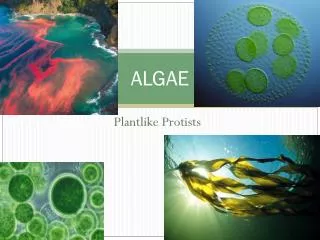
5. Algen, Beispiele Scenedesmus Wildstamm: Faden +Einzeller
Abschätzungen :Kollektorfläche und thermische Leistung • 1kW thermisch (aus C) ~ 440 g CO2/h ≈62.9 m2 • 5kW 2.2 kg CO2/h ≈ 315 m2 • 10 kW 4.4 kg CO2/h ≈ 629 m2 • Pro Tonne CO2 entstehen 680 kg Biomasse
Abschätzungen :Kollektorfläche und thermische Leistung • 1kW thermisch (aus C) ~ 440 g CO2/h ≈62.9 m2 • 5kW 2.2 kg CO2/h ≈ 315 m2 • 10 kW 4.4 kg CO2/h ≈ 629 m2 • Pro Tonne CO2 entstehen 680 kg Biomasse
6. Optik • Sonnenlicht -Sammeln -Leiten: hohle Leiter mit r=99.8% - Verteilen in 3D: Stäbe, Röhren, Bündel • Künstliches Licht: Röhren, LED´s
7. Elektrische Eigenschaften A K NO3- K+
7.Ernte: Elektrokoagulation Elektrokoagulation Elektroden Material: • Fe / Fe • Al / Al Variierte Parameter: • Stromstärke • Elektrolysezeit • pH-Wert • Konzentration Messung: • OD[750nm] / TM [mg/L] • SAK[436nm] • SSH 2h[mL]
8.Anwendungen • in sonnenreichen Ländern: Biomasse - Futtermittel / Düngemittel -Bioethanol -Biodiesel • Algen als Biofilter - Geruchsfilter - Abluftreinigung von C-Verbindungen