Understanding Aperture
This guide explores the fascinating relationship between the human eye, light, and aperture in photography. Learn how the cornea, iris, and lens work together to control light entering the eye and focus it onto the retina, transforming light into sight. Discover how aperture size affects depth of field, with larger apertures (like f/2.8) isolating subjects by blurring the foreground and background, while smaller apertures (like f/11) keep everything sharp. Understand how these principles enhance photographic composition and visual storytelling.

Understanding Aperture
E N D
Presentation Transcript
Understanding Aperture Mrs. Dornbach
THE HUMAN EYE - Light & Sight • The cornea allows light to enter the eye. • As light passes through the eye the iris changes shape by expanding and letting more light through or constricting and letting less light through to change pupil size. • The lens then changes shape to allow the accurate focusing of light on the retina. • Light excites photoreceptors that eventually, through a chemical process, transmit nerve signals through the optic nerve to the brain. • The brain processes these nerve impulses into sight. Diagrams & Information courtesy of health guide/howstuffworks.com
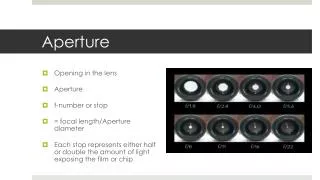
THE APERTURE - Light & Depth of Field At f/2.8 only the focused subject will be sharp; foreground and background won't. With smaller apertures (f11) everything in the scene will be very sharp. Diagrams & Information courtesy of PhotoAficionado.com
Remember… The smaller the Number, (More light with narrow depth of field)The larger the Aperture. The larger the Number, (Less light with wide depth of field) The smaller the Aperture.