Download
1 / 22
220 likes | 331 Vues
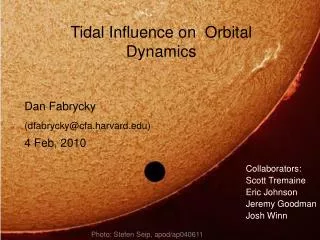
This study by Rory Barnes and colleagues explores the implications of tidal forces on the habitability of exoplanets, particularly focusing on GJ 581. It examines the effects of tidal locking, tidal heating, and their impact on planetary orbits and environments. The research highlights that while excessive tidal heating can render planets uninhabitable, moderate heating may facilitate conditions suitable for life. Furthermore, the concept of a "Tidal Habitable Zone" is introduced, emphasizing the need to consider tidal dynamics in the search for habitable worlds beyond Earth.

E N D
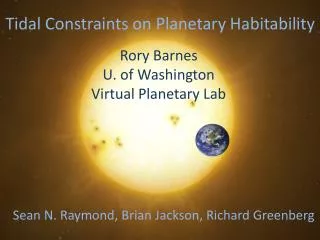
Tidal Constraints on Planetary Habitability Rory Barnes U. of Washington Virtual Planetary Lab Sean N. Raymond, Brian Jackson, Richard Greenberg
Sun From Selsis et al. (2007) Mass of Star (M) GJ 581 Likely habitable Possibly habitable Distance from Star (AU)
Tides Important Sun Mass of Star (M) GJ 581 Distance from Star (AU)
Tidal Locking ≠ Synchronous Rotation! Sun Porb Mass of Star (M) Prot ∞ 1 + e2 GJ 581 obliquity 0 Distance from Star (AU)
Sun Porb = 66 d e = 0.38 Prot = 28 – 39 d Mass of Star (M) GJ 581 ? High e => more habitable Distance from Star (AU)
Williams & Pollard (2002) + Selsis et al. (2007) GJ 581 No Clouds Total cloud coverage Barnes et al. (2008)
But tides circularize orbits… semi- major axis HZ Orbit 0.2 M
Orbital Decay -> Tidal Heating Io has ~2 W/m2 heat flux Such heating could be bad for life
But Some Heating is Good… Plate tectonics requires ~40 mW/m2 (Williams et al. 1997) Prevents runaway greenhouse
If heating > 2 W/m2 => uninhabitable If 0.04 < heating < 2 W/m2 => habitable If heating < 0.04 W/m2 => uninhabitable (need radiogenic sources)
d c e
Super- Earth? “Super- Ios”
or Super- Mars? “Super- Ios”
e = 0.01 e = 0.5 10 M
Summary • Tidal locking ≠ Synchronous rotation • Rotation rates are faster • Obliquities go to zero • Tides may remove planets from HZ • Tidal heating may be severe (super-Io) • But tidal heating may drive plate tec. • “Tidal Habitable Zone” • First-detected rocky planets in HZ • will be affected by tides
ec = 0.01 ec = 0


![⭿ READ [PDF] ⚡ Fundamental Planetary Science: Physics, Chemistry and Habitability read](https://cdn7.slideserve.com/12924456/fundamental-planetary-science-physics-chemistry-dt.jpg)