Download
1 / 5
50 likes | 173 Vues
The Chi-square statistic is a crucial tool for assessing discrepancies between expected and observed values in experiments. It helps evaluate sampling fluctuations, comparing theoretical probabilities to experimental outcomes. For example, when flipping a coin, the expected value is 50% heads and tails, while the observed value may vary (e.g., 60 heads and 40 tails). The Chi-squared value quantifies how "weird" or unexpected the results are. A smaller Chi-squared indicates that the null hypothesis is more likely to be true, revealing insights into the relationship between observed data and theoretical predictions.

E N D
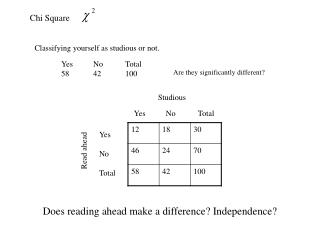
Chi Square Statistic Used to evaluate sampling fluctuation
Expected and Observed Values Expected value – what should happen, think of theoretical probability A coin should land 50% heads and 50% tails Observed value – the results from when you do the experiment, think of experimental probability Actually flipping a coin 100 times and getting heads 60 and tails 40
Chi Squared Measuring weirdness of something This calculation is used for all the observed values The chi squared is then the sum of all of the results
What does Chi Squared tell us What happens to the Chi Squared when the data gets weirder Use our data to come up with this answer
Assigning Probabilities Prob of getting this specific chis squared statistic or larger when null hyp is true The closer Chi Squared is to zero the more likely the null hyp is true The Closer the Chis squared is to zero the higher the percentage is