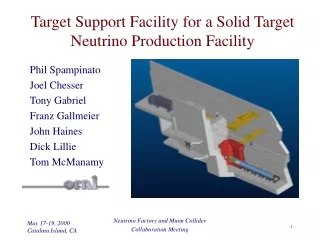
Investigation of Solid Tungsten Targets for Neutrino Factory Applications
This study focuses on the use of solid tungsten wire targets at 2000K in neutrino factory experiments. It involves the analysis of the mechanical and thermal properties of tungsten bars under proton beam exposure, with an emphasis on lifetime validation and understanding their behavior under specific conditions. Comprehensive testing techniques—including Laser Doppler Vibrometry and radiation damage assessments—are utilized to measure stress and oscillation patterns. The results indicate promising lifetimes and stress levels, which are critical for the longevity and safety of target operations in high-performance settings.

Investigation of Solid Tungsten Targets for Neutrino Factory Applications
E N D
Presentation Transcript
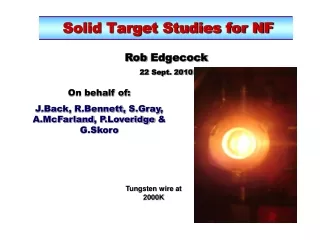
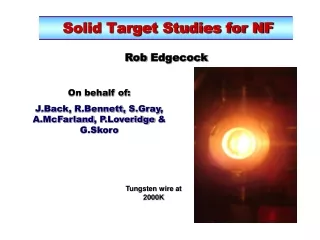
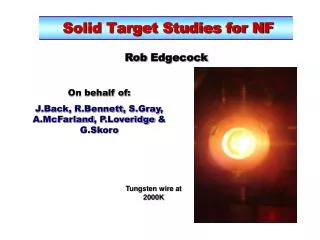
Solid Target Studies for NF Rob Edgecock On behalf of: J.Back, R.Bennett, S.Gray, A.McFarland, P.Loveridge & G.Skoro Tungsten wire at 2000K
Reminder • Solid means • tungsten bars, each ~2x20cm • 150-200 bars • changed between beam pulses • cooled radiatively or possibly by helium/water • Why? • lots of experience world-wide & safer • already have a license at RAL • Issues for solids: • shock – original show-stopper • radiation damage • target change • Focus has been on shock - but now moving on
Shock • Was solid show-stopper: one of main reasons for liquids • Impossible to lifetime test with proton beam, so Aims: measure lifetime validate LSDyna model understand W behaviour 60kV, 8kA PSU, 100ns rise time
I, II, III –> ‘chronology’. • We have got better with the tests over time (better clamping of the wire; better understanding of ‘violin modes’ –> better alignment of the wire) Better at lower temperature! More than sufficient lifetime demonstrated: > 10 years for 2cm diameter target > 20 years for 3cm diameter target Focus now: Measure stress; Confirm modelling. SEM imaging BegbrokeNano, Oxford Materials Characterisation Services The aim to observe any surface damage which might indicate the presence of thermal fatigue Results: inconclusive • Lifetime/fatigue tests results 200 targets
Laser Doppler Vibrometer • VISAR • Mis-informed that VISAR required at high temp • Large irreducible noise in our frequency range • Took a long time to get any (poor) results • LDV • Much, much, much, ................. better than VISAR • Works to >2300K • Used to measure wire surface velocity • Frequency analysis used to extract results • Compared with LSDyna other measurements
Laser beam Laser beam Wire Laser Doppler Vibrometer Longitudinal and radial mesurements possible • Longitudinal • Bigger oscillations: ~μm; lower frequency: ~20kHz • But.....temperature variation along wire • Wire fixed at one end, constrained at other • Oscillations more difficult to understand • Radial • Smaller oscillations: 50-100nm; higher frequency: ~12MHz • But......fixed temperature • Easier to model
Longitudinal oscillations Frequency analysis Longitudinal oscillations vs LSDyna
Radial oscillations Radial oscillations: frequency analysis vs LSDyna Radial oscillations vs LSDyna
Comparison with LSDyna • Oscillations are complicated • wire partially fixed to frame • frame also moves • violin modes, etc • Have pretty good agreement but studies continuing • Level of stress is correct • correct velocity is reproduced • wire is being stressed at above NF levels • Lifetime results are valid
‘Fit’ – will be used later for comparison Comparison with Measurements Concern: low strength from static measuremts at high temp • J.W. Davis, ITER Material Properties Handbook, 1997, Volume AM01-2111, Number 2, Page 1-7, Figure 2
If we know the Poisson’s ratio , density , root of corresponding Bessel function , wire radius r and measure the frequency f as a function of temperature then: Illustration Laser beam Wire Measurement in Wire Tests
Young’s Modulus of Tungsten • Results are very encouraging • But…… • E is not tensile strength • Tensile strength is what really matters • Expectation is E would fall rapidly once plastic • Can we check this? • Difficult with tungsten....having a go with Ta (see GS talk)
Young’s Modulus Conclusions • Measurements ~ comparable with existing • Details largely understood, but more work required • Bottom line: Strength remains high at high temperature and at high stress! • Reason why measured lifetime higher than some expected • Plans: • Continue detailed studies • Repeat lifetime tests, but measure with LDV over time • Use beams and measure with LDV to cf LSDyna - request made to ISIS - use Ilias’s facility at CERN
Radiation Damage • ISIS: • used tantalum for > 10 years, tungsten ~5 years • targets changed after ~12dpa • ~2-5 years at NF, depending on # of targets • no signs of swelling or embrittlement • Ta examined in detail; W still to be done • Still to be done • tensile strength after irradiation • hope to form consortium to measure 12dpa ISIS target • but……..
Radiation Damage NB Static measurements.
Target Change • Current option: a wheel – being investigated now • Several already used, but most relevant: design study Horizontal for compatibility with baseline target station
Target Change • For us, major issue is capture solenoid • Helmholtz coil looks difficult due to forces • Placing wheel up-stream of solenoids: ~60% of Study II muon capture rate
Target Change • Arranging visit to discuss collaboration with ESS • But.....problem being studied by ISIS TS2 engineers • Given free reign, uninhibited by physicists • Studying an idea with minimal impact on solenoids • More if it works out
Conclusions • Shock: • We’ve done this to death! • Don’t believe it is a problem • Tests with beams to come • Radiation damage: • Lots of local experience exists • Needs to be applied to our case • But existing data are encouraging • Target change: • Wheel looks feasible – detailed study underway • Alternatives being investigated