
Planetary Orbits and Newton's Law of Gravity
E N D
Presentation Transcript
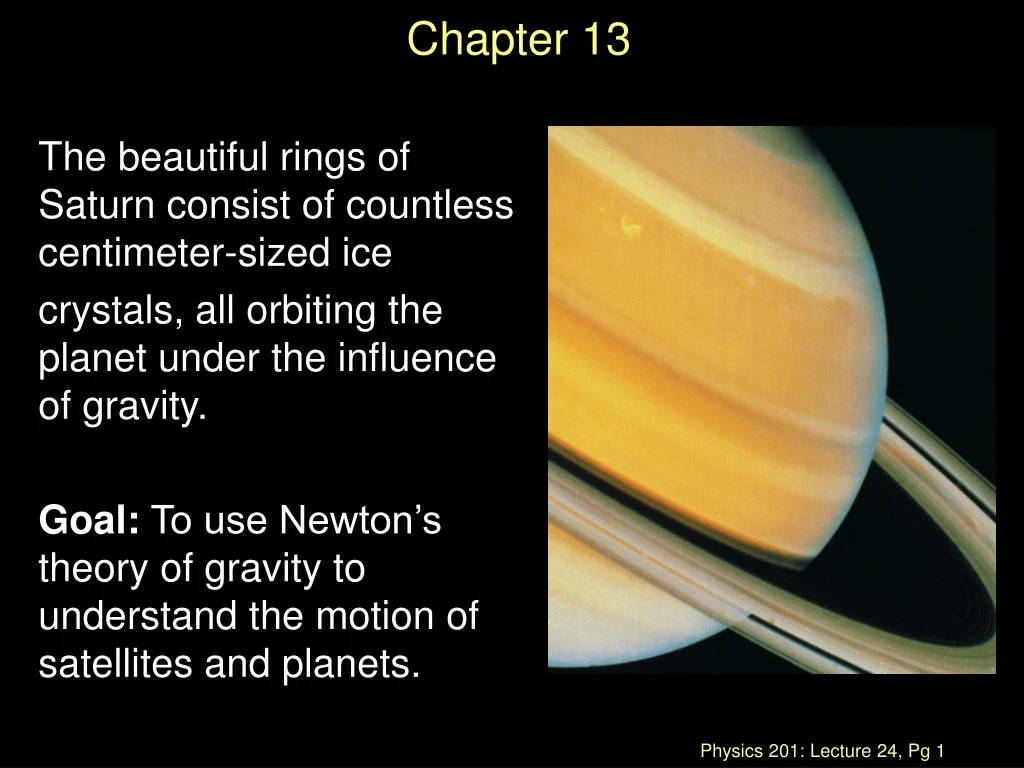
Chapter 13 The beautiful rings of Saturn consist of countless centimeter-sized ice crystals, all orbiting the planet under the influence of gravity. Goal: To use Newton’s theory of gravity to understand the motion of satellites and planets.
Who discovered the basic laws of planetary orbits? • Newton • Kepler • Faraday • Einstein • Copernicus
What is geometric shape of a planetary or satellite orbit? • Circle • Hyperbola • Sphere • Parabola • Ellipse
The value of g at the height of the space shuttle’s orbit is • 9.8 m/s2. • slightly less than 9.8 m/s2. • much less than 9.8 m/s2. • exactly zero.
Newton’s Universal “Law” of Gravity Newton proposed that every object in the universe attracts every other object. The Law: Any pair of objects in the Universe attract each other with a force that is proportional to the products of their masses and inversely proportional to the square of their distance
Newton’s Universal “Law” of Gravity “Big” G is the Universal Gravitational Constant G = 6.673 x 10⁻¹¹ Nm2 / kg2 Two 1 Kg particles, 1 meter away Fg= 6.67 x 10⁻¹¹ N (About 39 orders of magnitude weaker than the electromagnetic force.) The force points along the line connecting the two objects.
Newton’s Universal “Law” of Gravity You have three 1 kg masses, 1 at the origin, 2 at (1m, 0) and 3 at (0, 1m). What would be the Net gravitational force on object 1 by objects 2 & 3? G = 6.673 x 10⁻¹¹ Nm2 / kg2 Two 1 Kg particles, 1 meter away Fg= 6.67 x 10⁻¹¹ N Each single force points along the line connecting two objects. Fg=9.4 x 10⁻¹¹ N along diagonal
Motion Under Gravitational Force • Equation of Motion • If M >> m then there are two classic solutions that depend on the initial r and v • Elliptical and hyperbolic paths
Anatomy of an ellipse • a: Semimajor axis • b: Semiminor axis • c: Semi-focal length • a2 =b2+c2 • Eccentricity e = c/a If e = 0, then a circle Most planetary orbits are close to circular.
A little history • Kepler’s laws, as we call them today, state that 1. Planets move in elliptical orbits, with the sun at one focus of the ellipse. 2. A line drawn between the sun and a planet sweeps out equal areas during equal intervals of time. 3. The square of a planet’s orbital period is proportional to the cube of the semimajor-axis length. Focus Focus
Kepler’s 2nd Law • The radius vector from the sun to a planet sweeps out equal areas in equal time intervals (consequence of angular momentum conservation). • Why?
Conservation of angular momentum • Area of a parallelogram = base x height • L is constant (no torque)
Kepler’s 3rd Law • Square of the orbital period of any planet is proportional to the cube of semimajor axis a.
Little g and Big G Suppose an object of mass m is on the surface of a planet of mass M and radius R. The local gravitational force may be written as where we have used a local constant acceleration: On Earth, near sea level, it can be shown that gsurface ≈ 9.8 m/s2.
Cavendish’s Experiment F = m1 g = G m1 m1 / r2 g = G m2 / r2 If we know big G, little g and r then will can find the mass of the Earth!!!
Orbiting satellites vt = (gr)½ Net Force: ma = mg = mvt2 / r gr = vt2vt = (gr)½The only difference is that g is less because you are further from the Earth’s center!
Geostationary orbit • The radius of the Earth is ~6000 km but at 36000 km you are ~42000 km from the center of the earth. • Fgravity is proportional to 1/r2 and so little g is now ~10 m/s2 / 50 • vT = (0.20 * 42000000)½ m/s = 3000 m/s • At 3000 m/s, period T = 2p r / vT = 2p 42000000 / 3000 sec = = 90000 sec = 90000 s/ 3600 s/hr = 24 hrs • Orbit affected by the moon and also the Earth’s mass is inhomogeneous (not perfectly geostationary) • Great for communication satellites (1st pointed out by Arthur C. Clarke)
Tuesday • All of Chapter 13