Valuation of Concepts Using Conjugate Möbius Function: Hierarchies and Diversity Analysis
170 likes | 282 Vues
This study explores the valuation of concepts through the Conjugate Möbius Function (CMI), focusing on context and concept lattices. It examines the hierarchical structure of concepts, emphasizing their diversity and weights in relation to attributes like skills in team-building scenarios. By utilizing incidence matrices, the framework assigns values to concepts, facilitating a better understanding of dissimilarity and compact team formation. This research paves the way for future studies on optimizing skill coverage and enhancing team effectiveness based on conceptual analysis.


Valuation of Concepts Using Conjugate Möbius Function: Hierarchies and Diversity Analysis
E N D
Presentation Transcript
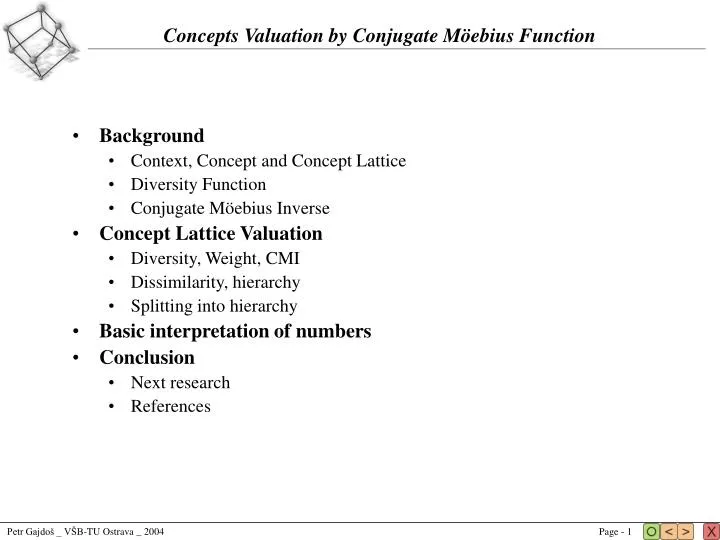
Concepts Valuation by Conjugate Möebius Function • Background • Context, Concept and Concept Lattice • Diversity Function • Conjugate Möebius Inverse • Concept Lattice Valuation • Diversity, Weight, CMI • Dissimilarity, hierarchy • Splitting into hierarchy • Basic interpretation of numbers • Conclusion • Next research • References
Context, Concept and Concept Lattice • Context • Incidence matrix Description of objects and features in incidence matrix. C = cat q = quadrupped (four feet) M = monkey (chimpanzee) p = pilli D = dog i = intelligence F = fish (delphinus) w = live in water H = human h = hand W = whale Whales live in water
Context, Conceptand Concept Lattice • Concept Sample of formal concept:({C,M,D},{p})
Context, Concept and Concept Lattice • Concept lattice
Concept Lattice Valuation • Diversity
Concept Lattice Valuation • Weighting by CMI
Concept Lattice Valuation • Dissimilarity There are two models in Theory of Diversity. Hierarchical a more generalline model. Concept lattice are hierarchical ordered. But, weighting of concepts is a difficult task. We can assign value to concepts only in small simly lattice because of next condition.
Concept Lattice Valuation • Splitting into hierarchies
Basic interpretation of numbers • What represent the numbers (diversity, weight) • For example, we have a set of different people with different skills. We are looking for teams of people (concepts), which can cover most of required skills. • 1. We assign value to each attribute. Higher value represents more important attribute. • 2. We compute diversities of concepts = v(Ci). • 3. v(Ci) / v(Ctop) … upon normalization we get a number that represents measure of covering of skills according to their values. • We want to find „compact“ teams (concepts) whose members have general knowledge. Compact = most of skills of pleople in the team are shared. • 1. We assign value to each attribute. Higher value represents more important attribute • 2. We compute diversities and weights of concepts = v(Ci), (Ci) • 3. v(Ci) / v(Ctop) … upon normalization we get a number that represents measure of covering of skills according to their values. • 4. (Ci) / (v(Ci) / v(Ctop))
Conclusion • Next research • Input • Output • Evaluated, reduced concept lattice Hierarchy of attributes Incidence matrix