Postpartum Care: Managing Hypertension and Eclampsia Risks After Delivery
After delivery, the greatest risk of eclampsia occurs within 48 hours. Magnesium should be continued for 24 hours post-delivery, and blood pressure (BP) must be closely monitored for 72 hours postpartum, possibly at home under specific circumstances. If SBP is >150/100 (4 hours apart), treat as per guidelines. Consider oral antihypertensives like nifedipine and labetalol, while avoiding NSAIDs. Future risks of cardiovascular disease increase post-pre-eclampsia; thus, lifestyle modifications, including exercise and a healthy diet, are essential.

Postpartum Care: Managing Hypertension and Eclampsia Risks After Delivery
E N D
Presentation Transcript
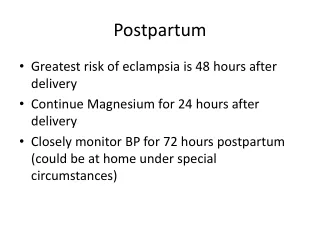
Postpartum • Greatest risk of eclampsia is 48 hours after delivery • Continue Magnesium for 24 hours after delivery • Closely monitor BP for 72 hours postpartum (could be at home under special circumstances)
Treat PP blood pressures if SBP > 150/100 at least 4 hours apartper guidelines, but can also treat if “persistently elevated” i.e. increase frequency of monitoring and don’t have to wait 4h before treating
Postpartum Antihypertensives • Oral nifedipine XL 30 mg daily • Oral labetalol 100-200 mg TID to start • If HTN persists > 24 hours avoid NSAIDS (probably a good idea to avoid in all with with hypertension) • BP needs to be rechecked 7-10 days after discharge, sometimes sooner
Future Risk • 2X increased risk of later-life CV disease (MI, CVA, CHF) in all pre-e (based on large epidemiological studies) • 8-9X increased risk in pre-e delivered before 34 wks • Pregnancy hx should be part of CV risk assessment
Future Risk Prevention • Pts should be advised: • Maintain ideal body weight • Aerobic exercise 5X/wk • Diet high in fiber/veggies/fruits, low in fat • Avoid tobacco • Task Force Recommendation (low quality evidence, qualified recommendation) • Hx of preterm delivery (<37 wks) for pre-e or hx of recurrent pre-e get yearly eval of BP, Lipids, fasting glucose, BMI