Feasibility studies for GPDs measurement at COMPASS
190 likes | 316 Vues
This document details feasibility studies for measuring Generalized Parton Distributions (GPDs) at the COMPASS experiment at CERN, with a focus on Deep Virtual Compton Scattering (DVCS) and exclusive production of the ρ0 meson. It highlights the expected physics impact, experimental challenges, and the development of a recoil detector prototype. Key aspects include the analysis of mass and angular distributions from present data and projected future experiments, addressing instrumental configurations and model constraints that inform our understanding of quark GPDs.


Feasibility studies for GPDs measurement at COMPASS
E N D
Presentation Transcript
Feasibility studies for GPDs measurement at COMPASS Jacques Marroncle, CEA/Saclay, DAPNIA/SPhN on behalf of the COMPASS collaboration DVCS or Deep Exclusive ρ0 production GPDs 1- DVCS studies for the future at COMPASS Physics impact Experimental issues Recoil detector prototype 2- Exclusive r0 production in the present COMPASS data Event Selection Mass distribution Angular distributions Spin-03 in Dubna - Russia September 16th – 20th, 2003
Generalized Parton Distributions g* g,p,r... Kinematicconditions : hard • DIS Q2 and W large • finite xBj x-ξ x+ξ soft • Factorization -t << Q2 GPDs P’ P t Properties : DIS = forward limit (t→0) 4 quark GPDs : H(x,0,0) = q(x) F1(t)
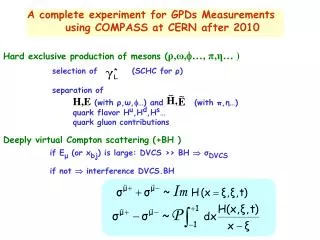
Deep VCS Bethe-Heitler DVCS observables P High energy cross section Low energy interference : SSA imaginary part of the amplitude BCA real part of the amplitude COMPASS – 200 GeV JLAB – 6 GeV HERMES – 27 GeV B-H DVCS (pB/GeV/sr2) B-H B-H Q2=3 GeV2 DVCS DVCS xB=0.3
DVCS in the world present future COMPASS wide Q2 and xBj range
Projected errors of apossibleDVCS experiment Beam Charge Asymmetry Ebeam = 100 GeV 6 month data taking 25 %global efficiency 6/18 (x,Q²) data samples Model 1 : simplest ansatz Model 2 :from Goeke et al. (L. Mossé,M. Vanderhaegen) Very promising Good constraint for models
Compass Setup (2002 – 2003) magnets muon filter Calorimeters ~ 200 detection planes Silicon, SciFi, Micromegas, Drift chambers, GEM, Straw chambers, MWPC RICH polarized target
DVCS experimental conditions p ~ 80 GeV/c q ~ 1 deg { m’ 2.5 m LH2 m µ’ and gCOMPASS equipment with additional calorimetry 100 GeV/c g (2 108 µ/spill) p > 3 GeV/c q < 10 deg { p p : 250 → 750 MeV/c q : 40 →70 deg { Need of a new recoil detector to be designed and built
Recoil Detector Concept Requirements : - Identify and measure protons - Identify neutrals D→np+, p0→gg - large detector - good hermeticity + COMPASS Setup
DVCS background Source :Pythia 6.1 generated DIS events Apply DVCS-like cuts final state m’+g+p in DVCS range no other charged & neutral in active volumes DVCS model Mossé, Vanderhaegen DVCS is dominant
Proof of principle Tests performed atCOMPASS(summer 2001) m’ m A B p Particle Identification Short Plastic scintillators Energy Loss vs TOF Target: 10 cm of CH2 ~ (2.5m of Liquid H2) Nominal beam conditions
Recoil detector prototype Goal :full test of feasibility of a 25 degree sector - scintillating material studies (timing at 200 ps over 4 m!) - fast triggering and multi-hit ADC/TDC system Funding approved by European Community Bonn-Mainz-Saclay-Warsaware participating Milestones : 2004– material selection, test bench and in-beam studies 2004/5– development of fast electronics 2005– construction >2005– integration and operation downstream of COMPASS
Exclusive r0 production withCOMPASSdata 2002 Data : E = 160 GeV - 2 x 60 cm polarized 6LiD target - semi-inclusive trigger - 1/6 of the data shown Event selection: - m, m’ - 2 hadrons of opposite charge - 0.5 <Mh+h-< 1 GeV - no other particles - n>30 GeV, Em’>20 GeV - -2 < DE < 2.5 GeV - |t| < 0.5 GeV2 Q² Q² Number of events (1/6 of 2002 data): 1300. 103r0 all Q² 18. 103r0 with Q²>1 GeV²
r0 mass distribution Söding parametrization: No acceptance corrections ! (subtracted)
is the fraction oflongitudinal (helicity 0)r°’s r0 angular distributions f Definitions : in g*-p CM frame p’ m’ p g* m r° p+ F in r° rest frame q p- Assuming s-Channel Helicity Conservation + parity with
r0 angular distributions ● 1/6 of 2002 data ●No acceptance corrections applied ●qualitative agreement with expected physics
Conclusions & Perspectives Exciting physics case Theory & experimental communities very active Proposal for DVCS at COMPASS in preparation COMPASS could provide important data DVCS cross section Beam Charge Asymmetry Exclusive meson production High statistics Studies of s-CHC Double spin asymmetries Hard Exclusive Meson Production
Proton detection efficiency Goal :evaluate inefficiency due to m interaction in the target • GEANT Simulation: • - real attenuation length • segmentation (24 sectors) • vary target • shielding thickness Inefficiency = 30 % occupancy from Möller electrons
Existing Data CLAS at JLAB HERMES H1 Phys.Lett.B517 (2001) 47 PRL 87 (2001) 182001 PRL 87 (2001) 182002
Single Spin Asymmetry Beam Charge Asymmetry Polarised beam +/- chargedbeam DVCS observables Deep VCS Bethe-Heitler Lower energy use interference - holography High energy beam Cross section (BCA) (SSA)