Exploring Generalized Parton Distributions through DVCS: Insights from the COMPASS Collaboration
The COMPASS collaboration has been investigating Generalized Parton Distributions (GPDs) using Deeply Virtual Compton Scattering (DVCS) and exclusive processes. This study aims to enhance our understanding of the internal structure of nucleons through GPDs, with experiments conducted using a high-energy muon beam. The collaboration has addressed various experimental challenges, including prototype recoil detectors and achieving optimal beam polarization and intensity settings. The results provide critical insights into GPDs and their role in particle physics, contributing to our knowledge of the quark distributions within nucleons.

Exploring Generalized Parton Distributions through DVCS: Insights from the COMPASS Collaboration
E N D
Presentation Transcript
GPDs studies at COMPASS Etienne Burtin, CEA/Saclay, DAPNIA/SPhN on behalf of the COMPASS collaboration DVCS studies for a GPD experiment in 2010 Physics impact Experimental issues Recoil detector prototype Exclusive r0 production in present COMPASS data Principle Preliminary 2002 results SIR workshop 2005 May 19, 2005 – Newport News, VA
Generalized Parton Distributions g* g,p,r Factorisation: Q2 large, -t<1 GeV2 hard x+x x-x soft GPDs P P’ t Generalized Parton Distributions H(x,0,0) = q(x) measured in DIS for quarks : 4 functions H(x,x,t) F(t) measured inelastic scattering
Single Spin Asymmetry Beam Charge Asymmetry Polarised beam +/- chargedbeam DVCS observables Deep VCS Bethe-Heitler High energy beam Lower energy=> use interference - holography Cross section COMPASS muon beam can do all !
Collimators 1 2 3 4 H V H V scrapers T6 primary Be target Compass target Be absorbers Protons 400 GeV Muon section 400m Hadron decay section 600m Polarized μ+andμ-beams • Solution proposed by Lau Gatignon: • To select Pπ=110GeV andPμ=100GeV • to maximise the muon flux • 2) To keep constant the collimator • settings which define • the π and μ momentum spreads • Pol μ+ = -0.8andPol μ- = +0.8 • I(μ+) ~ 2. I(μ-) • switch in ~10 mins (once per shift?) Requirements for DVCS: -same energy -maximum intensity -opposite polarisation to a few % -change of beam charge frequent 2.108 muons/spill 1.3 1013protons/spill
dσ(μpμp) = dσBH + dσDVCSunpol + PμdσDVCSpol + eμ aBHReADVCS + eμ PμaBHImADVCS μ’ * θ μ p φ cos nφ sin nφ Extraction of GPDs in the case of μ+ / μ- Extraction of GPDs in the case of t, ξ~xBj/2 fixed Pμ+=-0.8 Pμ-=+0.8
E=190, 100GeV Nx2 new LINAC 4 (SPS injection) in 2010 could COMPASS benefit from this ? Kinematical domain Collider : H1 & ZEUS0.0001<x<0.01 Fixed target : JLAB 6-11GeV SSA,BCA? HERMES 27 GeV SSA,BCA COMPASScould provide data on : Cross section (190 GeV) BCA (100 GeV) Wide Q2 and xbj ranges Limitation due to luminosity
model 1 model 2 BCA Sensitivity of BCA to models Model 1: H(x,ξ,t) ~ q(x) F(t) Model 2: from Goeke, Polyakov and Vanderhaeghen H(x,0,t) = q(x) e t <b2> = q(x) / xα’t COMPASS sensitivity to the different spatial distribution of partons when xBj Good sensitivity to models in COMPASS xBj range
Projected errors of a possible DVCS experiment Beam Charge Asymmetry L = 1.3 1032 cm-2 s-1 Ebeam = 100 GeV 6 month data taking 25 % global efficiency 6/18 (x,Q²) data samples 3 bins in xBj= 0.05, 0.1, 0.2 6 bins in Q2 from 2 to 7 GeV2 Model 1 : H(x,ξ,t) ~ q(x) F(t) Model 2 : H(x,0,t) = q(x) / xα’t Good constrain for models
Additionnal equipment to the COMPASS setup all COMPASS trackers: SciFi, Si, μΩ, Gem, DC, Straw, MWPC μ’ 2.5 m Liquid H2 target to be designed and built ECAL 1 or 2 12° COMPASS equipment with additional calorimetry at large angle p’ μ Recoil detector to insure exclusivity to be designed and built
Physical Background to DVCS Source :Pythia 6.1generated DIS events Apply DVCS-like cuts one m’,g,p in DVCS range no other charged & neutral in active volumes detector requirements: 24° coverage for neutral 50 MeV calorimeter threshold 40° for charged particles in this case DVCS is dominant
24° ECAL0 12° 4m Possible solution for the recoil detector proposed in the Workshop on the Future Physics at COMPASS 26 Sept2002 Received funding by EU FP6 (Bonn-Mainz-Saclay-Warsaw ) Goal : full test of a prototype of a 45 degree sector - scintillating material studies (timing at 200 ps over 4 m) - fast triggering and multi-hit ADC/TDC system Also studying a scintillating fibers solution (Monte-Carlo) with good timing provided by incoming or scattered muons
Hard Exclusive Meson Production It comes for free with the recoil detector and existing COMPASS trackers Cross section: Vector meson production (ρ,ω,…) H & E Pseudo-scalar production (π,η…) H & E ~ ~ Hρ0 = 1/2 (2/3Hu + 1/3Hd + 3/8Hg) Hω= 1/2 (2/3Hu – 1/3Hd + 1/8Hg) H = -1/3Hs - 1/8Hg Can be investigated with present COMPASS data Single spin asymmetry ~ E/H for a transverse polarized target
Compass Set-up 2002-2003 at CERN 250 physicists 26 institutes magnets muon filter Calorimeters 160 GeV pol. m beam ~ 200 detection planes Silicon, SciFi, Micromegas, Drift chambers, GEM, Straw chambers, MWPC RICH polarized target
m’ p- m Mpp Assuming both hadrons are p: 0.5 < Mpp< 1 GeV r0 g* p+ N N’ Emiss Exclusivity of the reaction Emiss=(M²X-M²N)/2MN -2.5 < Emiss < 2.5 GeV Incoherent production: 0.15 < pt²< 0.5 GeV² scattering off a quasi-free nucleon pt² Incoherent exclusive r0 sample selection Event topology: • Kinematics : • n > 30 GeV • Em’ > 20 GeV • Q² > 0.01 GeV²
r0 angular distributions f Definitions : in g*-p CM frame p’ m’ p g* m r° p+ F inr° rest frame q p- The angular distribution W(cosq,f,F) depends on the r0 spin density matrix elements 23 (15) measurable with polarised (unpol.) beam This analysis : one-dimension distributions test of s-Channel Helicity Conservation SCHC Distributions are corrected for acceptance. Background not subtracted. Statistical error limited by MC sample (except last Q² bin).
Measurement of r 04 00 Distribution : Spin density matrix elements: Tlg are helicity amplitudes meson photon
Measurement of r and Im r 04 1-1 3 1-1 beam polarisation weak violation if SCHC holds: R can be extracted
2002 2003+ Determination of Rr° =sL/sT as SCHC holds …: only T00≠0 T11≠0 Then : Impact on GPD : sL is dominant at high Q² (factorisation only valid for sL) High statistics from g-production to hard regime better coverage at high Q² more data to come …
Conclusions Exclusive vector meson production in COMPASS data - preliminary results from 2002 data - allow test of SCHC - shows dominance of sL at Q²>2GeV² - more data on tape with better coverage at high Q² to come - insight on GPDs : transverse asymmetry and cross section measurements Towards a GPD experiment using COMPASS… - COMPASS is complementary to other experiments - has good sensitivity to GPD models through BCA - has good Q² range for 0.03<xbj<0.2 - will be able to measure Hard Exclusive Meson Production - seeking collaborators… This initiative is now an “Express of Interest” : SPSC-EOI-005 http://doc.cern.ch//archive/electronic/cern/preprints/spsc/public/spsc-2005-007.pdf COMPASS should also be a good place to study GPD in 2010 !
Gatignon compass Proton luminosity upgrade at CERN
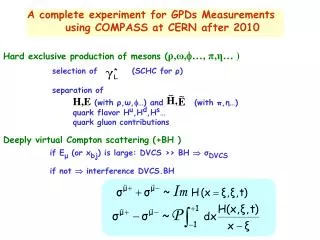
μ’ * θ μ p φ μ μ DVCS+ Bethe Heitler p p BH calculable The high energy muon beam at COMPASS allows to play with the relative contributions DVCS-BH which depend on 1/y = 2 mp Eℓ xBj/Q2 Higher energy: DVCS>>BH DVCS Cross section • Smaller energy: DVCS~BH • Interference term will provide the DVCS amplitude