Muscular System
290 likes | 402 Vues
Explore the muscular system's crucial role in supporting movement through engaging activities like the chicken wing dissection and tennis ball muscle exploration. Learn about the three types of muscles: smooth, cardiac, and skeletal, and their functions. Discuss involuntary and voluntary muscle actions, how muscles contract through the sarcomere, and the importance of exercise for muscle health. This comprehensive overview invites students to investigate principles of muscle function and appreciate the complex interplay of muscles in movement.


Muscular System
E N D
Presentation Transcript
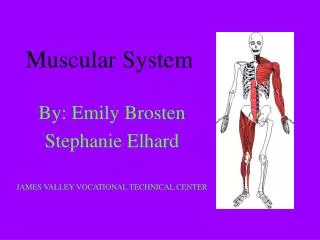
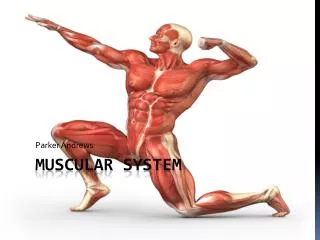
Muscular System Muscles for Locomotion
Engage • Tennis Ball Muscle Activity
Explore • Chicken Wing Dissection • The major function of the muscular system is to support our body in movement. Through observations and class discussion, you will make deduction about certain principles of muscle function.
Explore • “Multitalented Muscles” Web Search
Explain • What are some functions of the Muscular System? • Contract and relax to move the body. • Stores energy • Protects internal organs
Two Muscle Categories • Involuntary • NOT under conscious control • Voluntary • Under conscious control
Think About It!! • Can you think of one body function that you perform without thinking about it? • Breathing, Heart Beating, Digestion, etc… • How about one that one must think about? • Picking up a pencil, walking, running, etc…
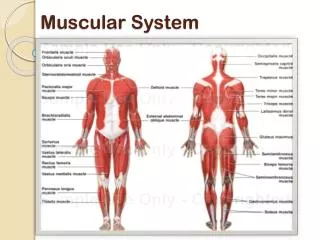
Three Types of Muscles • Smooth Muscle • Cardiac Muscle • Skeletal Muscle
Smooth Muscle • Where lining of Internal Organs and Blood Vessels • Involuntary • Non striated • Function Squeeze, exert pressure by slow and prolonged contractions
Cardiac Muscle • Where Heart • Involuntary • Striated and branched
Skeletal Muscle • Majority of muscle in the body • Voluntary • Striated • Found attached to the skeleton by TENDONS.
Questions • What are the two categories of muscles? • What are the three types of muscles? • Muscle that contract under conscious control are _________. • ______ attaches muscle to bone.
Skeletal Muscle Structure • Muscle - made of bundles • Bundles- many muscle fibers • Muscle Fiber – many myofibrils • Myofibrils- filaments (thick or thin) • Thick filaments –myosin protein • Thin filaments –actin protein • Thick and Thin give striated look
Functional Unit of Muscle • Sarcomere • Section of myofibril
Cycle Diagram 1 Myosin forms cross-bridge with actin 5 2 Myosin returns to original shape Cross-bridge changes shape 4 3 Cross-bridge releases actin Actin pulled
Cycle Diagram 1 Myosin forms cross-bridge with actin 5 2 Myosin returns to original shape Cross-bridge changes shape 4 3 Cross-bridge releases actic Actin pulled
Muscle Attachment to Bone • Muscles attached to bone by tendons. • Muscles are attached in opposing pairs. • One Muscle contracts to raise the limb, while the second will contract to lower it. • Bicep / Triceps
Figure 36-11 Opposing Muscle Pairs Section 36-2 Movement Movement Biceps (relaxed) Biceps (contracted) Triceps (contracted) Triceps (relaxed)
Muscle Strength and Exercise • Strength DOES NOT depend upon the number of fibers. Why? • Born with all fibers we will have. • Depends on the THICKNESS of fibers and how many contract at one time
Muscle Soreness After Exercise • Do muscle cells need O2? • Yes!!! • Do muscle cells need ATP? • Yes!!! • Working out moderately provides us enough oxygen (aerobic) to change glucose into ATP • Called _________ respiration • Working out rigorously does not allow us to get enough O2 in our blood. What happens with no O2 (anaerobic)? • Lactic Acid Fermentation • Lactic Acid builds up in muscle cells passes into the blood stream, causes the blood to become acidic, stimulates breathing, and can cause cramping
Regular Exercise • Improves functioning of muscles • Aerobic training can affect a muscle’s ability to share and use energy • Increases endurance and thickness of muscle filaments (strength)
Elaboration • The Universe Within • Watch the coordination of several different body systems and how they make Mike Powell the world’s greatest long jumper. • Muscle Builders! • Using various materials, you will build a model that simulates muscle contractions and relaxations. This model depicts one muscle working in isolation, but as we have learned, muscles in the body cooperate in a group effort, like in the chicken wing.