Understanding Past Tenses in English: Simple, Continuous, Perfect Forms
This resource explores the various past tense forms in English, including Past Simple, Past Continuous, Present Perfect Simple, Present Perfect Continuous, Past Perfect, and Past Perfect Continuous. It explains their uses, such as describing completed actions, habitual activities, and actions in progress. You'll learn how to express nostalgia with 'used to' and 'would', understand the importance of negative forms, and gain clarity on how to differentiate between completed and ongoing actions. With examples and detailed explanations, this guide is perfect for mastering past tenses.

Understanding Past Tenses in English: Simple, Continuous, Perfect Forms
E N D
Presentation Transcript
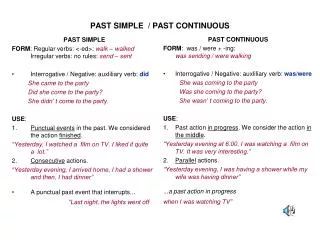
Past Simple • - Itreferstocompleted • actions: I woke up, watchthe time and fallsleep again. • habits: Everyday I wenttothegym. • states: In thosedays I didn’tlike vegetables.
Usedto and Would • Usedto, totalkaboutpasthabits. Thereis no present tense form. • I usedtogoswimming a lot (butnotnow). • Thenegativeformiseither: I didn’t use toor I usednotto … • Theform “I didn’tusedto” isincorrect. • I describes repeatedactions and habitual activitynotstates: • Everyweekhe’dbuyhismother a bunch of flowers. • Everyweekweusedtobuyhismother a bunch of flowers. • Wouldis more common in writtenlanguage and oftenoccurs in reminiscence (nostalgicmemories).
PastContinuous • Pastaction in progress: • I washavingbreakfast at that time. • Itmaybeinterruptedbyanotheraction: • While I washaving a shower, thetelephonerangtwice. • Backgrounddescription in narratives: • I enteredthe office and lookedaround. Mostpeoplewereworking at theirdeskbut James wasstaringoutof thewindow and pretendingtowritesomething at thesame time.
PastContinuous • Repeatedactions: followedby a frequentadverb. • Itis similar tothe use of thepresentcontinuouswithfrequentadverbstoexpressannoyance. • My motherwasalwaystelling me what I hadto do.
PresentPerfect Simple • Recenteventwithout a definite time given. • They’vejustgotmarried. • Pasteventwhichhappened at anunknown time. • I’vebeentotheStatetwice. • Pasteventwithanobviousresult in thepresent. • I’vetwisted my ankle. That’swhyI’mlimping. • Withstateverbswhichlast up tothepresent. • I’velivedhereforthepast 10 years. • I’vehadthisskateboardsince I was a child.
PresentPerfectContinuous • A statewhichlast up tothepresent: • I’vebeenwaitingforyouforthreehours. • Anincompleteactivity: • I’vebeencleaningthehousebut I stillhaven’tfinished. • Toemphasizeduration: • I’vebeen cleaningallmorning. • A recentfinishedactivity: • I ‘ve beenrunning. That’swhy I look hot. • A repeatedactivity: • I’vebeentakingFrenchlessonsthisyear.
ContrastwithPresentPerfect Simple • Thereis a littlecontrastwhensomestateverbs are used: • Howlonghaveyoulivedhere? • Howlonghaveyoubeen living here? • Someverbspreferthecontinuousform: sit, lie, wait, stay… • Theremaybe a contrastbetweencompletion and incompletion: • I’veironedfiveshirts. (completedaction) • I’vebeenironing my shirts. (incompletedaction)
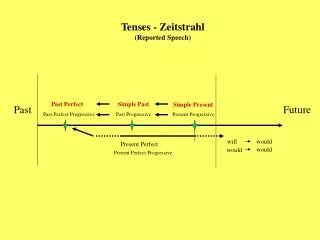
PastPerfect • We use itwhenwe are talkingaboutthepast and wewanttogo back toanearlierpast time. • Bythe time I gottothestation, thetrainhadleft.
PastPerfectContinuous • We use itwhenwe are talkingaboutthepast and wewanttogo back toanearlierpast time focussing in theprogression of theaction. • I wasworriedbecause he hadbeendrinking a lot. • Tosayhowlonganactionhadbeen in progress up to a certainpoint. • Bytheage of 18, I hadbeenstudyingEnglishfor 6 years.