Soil-Vegetation-Atmosphere Transfer (SVAT) Models
310 likes | 931 Vues
Soil-Vegetation-Atmosphere Transfer (SVAT) Models. Dr. Mathew Williams. What are SVAT models?. Simulators of energy and matter exchange between land surface and atmosphere Based on mechanistic understanding of the component systems


Soil-Vegetation-Atmosphere Transfer (SVAT) Models
E N D
Presentation Transcript
Soil-Vegetation-Atmosphere Transfer (SVAT) Models Dr. Mathew Williams
What are SVAT models? • Simulators of energy and matter exchange between land surface and atmosphere • Based on mechanistic understanding of the component systems • Used by meteorologists, climatologists, ecologists and biogeochemists.
Why do we need SVAT models? • To assist understanding of observations • To allow hypothesis testing • To extend understanding across space and time • To provide a basis for prediction
Model Jargon • State variables • Parameters • Driving variables • Calibration • Corroboration/validation/testing • Sensitivity analysis
What is the structure of a typical SVAT model? • Radiative transfer • Energy balance • Turbulent and diffusive transfer • Stomatal function • Photosynthesis and respiration • Liquid phase water flow
Small Group Task • For a SVAT component, define the sub-model structure • What are the driving variables, the parameters and state variables? • What are the key connections to other SVAT sub-models? • How would you calibrate your sub-model?
Radiative Transfer reflectance • Direct and diffuse • NIR vs PAR • Solar geometry • Foliar geometry • Sunlit and shaded Absorptance transmittance Beer’s Law: I=Io exp(-kL)
Energy Balance First law of thermodynamics: Energy is always conserved Qlin Qh Qe Qlout Qs Qs + Qe + Qh + Qlin + Qlout + Qc = 0 Qc
Turbulent and Diffusive Transfer J = g dc/dz Wind within Crops and forests Turbulent zone Laminar zone Boundary layer thickness - leaf size - wind speed - temperature Wind speed
Stomatal Function E = gsDcw gs is responsive to: CO2 Light Leaf water Humidity Empirical vs. mechanistic approaches
Penman-Monteith Equation g = psychrometer constant racp = volumetric heat capacity of dry air s = slope of saturation vapour pressure curve l = latent heat of vapourisation Rn = net radiation de = vapour pressure deficit ga = leaf boundary layer conductance gl = leaf stomatal conductance gH = heat conductance
Photosynthesis and Respiration light CO2 + 2H2O CO2 + 4H + O2 (CH2O) + H2O + O2 LIGHT REACTIONS DARK REACTIONS Metabolic model = Diffusion model Vc(1-G*/Cc)–Rd = gt(Ca-Cc)
CO2 Atmosphere gs E Leaf Yl Rp Stem C Rs1 Rr1 Roots Ys1 Rs2 Rr2 Ys2 Rsn Rrn Ysn Soil Plant Liquid Phase Water Flow What determines: Root resistance (Rr)? Plant resistance (Rp)? Soil resistance (Rs)? Soil water potential (Yl)?
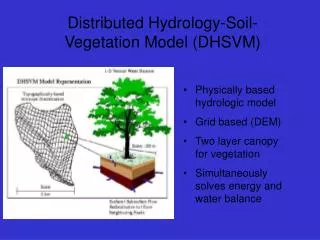
The Soil-Plant-Atmosphere Model • Multi-layer canopy and soils • 30 minute time-step • Fully coupled liquid and vapour phase water fluxes • Biochemical model of photosynthesis
What you should have learned • Structure of typical SVAT models • Diagnostic uses (working with eddy flux data) • Prognostic uses (scaling up) • Key research areas in developing SVAT models (applicability to global change research)