
Management and Surgical Considerations for High-Risk T1 Bladder Tumors and Muscle-Invasive Cancer
This article discusses the treatment options for patients with T1 tumors at high risk of progression, including characteristics such as high grade, multifocality, CIS, and tumor size. It emphasizes the significance of initial intravesical therapy and the critical timeframes for cystectomy to avoid increased extravesical disease. Guidelines for lymphadenectomy in locally advanced cases are reviewed, highlighting controversies and survival benefits. The article also covers urinary diversion options, contraindications for continent diversion, and the role of patient-surgeon collaboration in decision-making.

Management and Surgical Considerations for High-Risk T1 Bladder Tumors and Muscle-Invasive Cancer
E N D
Presentation Transcript
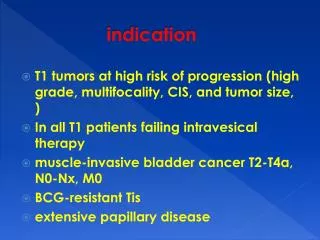
indication • T1 tumors at high risk of progression (high grade, multifocality, CIS, and tumor size, ) • In all T1 patients failing intravesical therapy • muscle-invasive bladder cancer T2-T4a, N0-Nx, M0 • BCG-resistant Tis • extensive papillary disease
performance status and age influence the choice of primary therapy, as well as type of urinary diversion with cystectomy being reserved for younger patients without concomitant disease and better performance status
Timing and delay of cystectomy delay of treatment beyond 90 days of primary diagnosis caused a significant increase in extravesical disease (81 vs 52%)
Before cystectomy, the patient should be counselled adequately regarding all possible alternatives, and the final decision should be based on a consensus between patient and surgeon.
Technique and extent • prostate and seminal • urothelial cancer in the prostate was detected in 33% • in23-54% of patients a prostate cancer is found • uterus and adnexa in women • spare seminal vesicles and the prostatic capsule
Role of Lymphadenectomy • provides insight into the local extent • In limited nodal burden increase survival
dissection of regional lymph nodes. There is a substantial amount of literature about the extent of lymphadenectomy. Yet, data regarding its clinical significance are controversial In retrospective studies extended lymphadenectomy (removal of the obturator, internal, external, common iliac and presacral nodes as well as nodes at the aortic bifurcation) has been reported to improve survival
standard lymph node dissection • genitofemoralnerve laterally • internal iliac artery medially • Cooper ligament caudally, • and the crossing of the ureter at the common iliac artery cranially
Ileal Conduit • It is simplest type of conduit diversion to perform and isassociatedwith the fewest intraoperative and immediatepostoperativecomplications
Colon Conduit • transverse colon is used when one wants to be surethatthe segment of conduit employed has not been irradiated • sigmoid conduit is a good choice in patients undergoing a pelvic exenteration who will have a colostomy
Contra-indications continent urinary diversion • Debilitating neurological and psychiatric illnesses. • Limited life expectancy. • Impaired liver or renal function. • Transitional cell carcinoma of the urethral margin or other surgical margins