Plate Tectonics
Explore the intricate composition of the Earth, from its outer crust to the inner core. This overview covers the two types of crust—oceanic and continental—as well as the layers of the mantle and core. Learn about tectonic plates, their movements, and how they lead to natural phenomena like earthquakes and volcanoes. The theory of continental drift, proposed by Alfred Wegener, is also discussed, illustrating the concept of Pangaea and the supporting evidence. Uncover the Earth's dynamic structure and the essential processes that shape our planet.


Plate Tectonics
E N D
Presentation Transcript
Plate Tectonics By: Courtney Czaplicki & Lauren Ross Period 1. 9/30/11
Composition of the Earth. • Crust- The crust of the Earth is the outermost layer. There are two types of crust : Oceanic and Continental. • Continental crust is thicker than the Oceanic crust. • The Mantle is under the crust. The mantle is super thick and contains most of the planet’s mass.
Composition of the Earth • The Core- There are two sections of the core Inner and Outer. • The Outer core is liquid iron. • The Inner Core is solid iron. It is solid because of the pressure put on it.
Structure of the Earth. • The outermost layer of the Earth is called the lithosphere. This portion of the Earth includes the crust and the ridged upper part of the mantel. • The Asthenosphere is directly under the Lithosphere. The Asthenosphere is made of solid rock that flows very slowly.
Structure of the Earth • The lower part of the Mantle is called the Mesosphere. The Mesosphere extends to the core. • Outer core / Inner core. Both made of Iron and Nickel. Outer core is liquid Inner core is solid and dense. Inner core is around 6,378km below the surface.
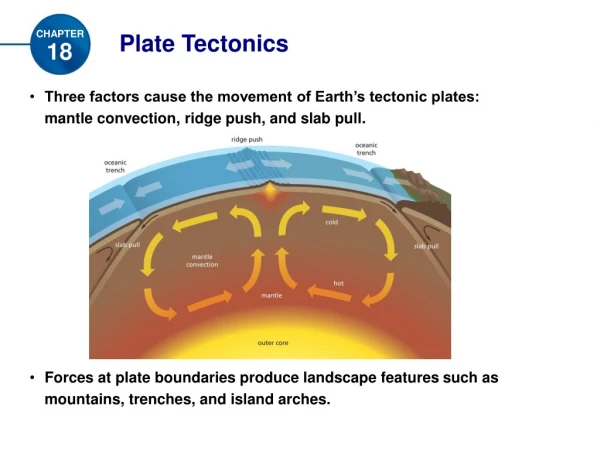
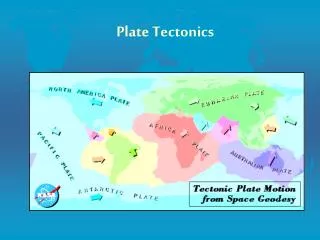
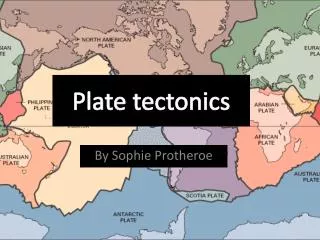
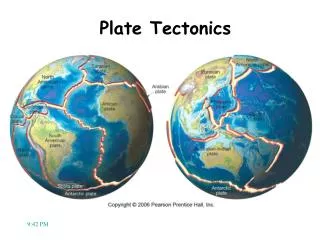
Tectonic Plates • Pieces of the Lithosphere or crust that slides around on top of the Mantel. • There are 15 major plates and hundreds of smaller ones. • Scientists say that the plate tectonic system is like that of a jigsaw puzzle.
Earthquakes and Volcanoes. • Earthquakes and Volcanoes are caused by tectonic plates moving away, crashing into, or sliding past one another. • Divergent Boundary- when plates move away from each other. • Convergent Boundary- Plates crash into each other. One plate sub ducts underneath the other plate. • Transform Boundary- Plates slip past each other
Continental Drift. • The Scientist that first thought about continental drift was Alfred Wegner • He was looking at a map and thought that the coast lines of South America and Africa looked like they’d fit together like a puzzle.
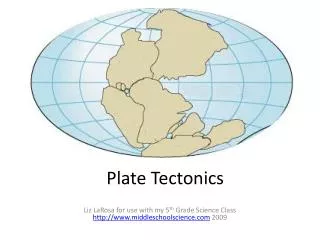
Pangaea. • Wegner thought that all of the present continents and islands once fit all together like a huge jigsaw puzzle. • He called this landmass Pangaea. • Pangaea is Greek for “all Earth”.
Evidence. • Wegener studied coastlines, fossils of animals and where they were found, and glacial patterns and evidence. • He discovered that many of the continents had the same plant and animal fossils found on them.
Works Cited. • Holt Science and Technology – Earth Science 2004. • Pangaea image was found at - http://www.pangaeapartners.com/ • Pangaea evidence was found at- http://www.moorlandschool.co.uk/earth/pangea.htm • Wegner’s photo was found at- http://www.uni-graz.at/en/igamwww/igamwww_praesentation.htm • Structure of the Earth was found at- http://www.physicalgeography.net/fundamentals/10h.html