Comprehensive Guide to Foul Recognition in U.S. Soccer: Grade 7 Referee Course
Enhance your officiating skills with this comprehensive training module designed for Grade 7 referees in the U.S. Soccer Federation. This course focuses on foul recognition, game control, and player management in an amateur adult training environment. Key topics include understanding player expectations, the nature of fouls, critical factors for evaluation, and maintaining game flow. Referees will learn to effectively manage on-field situations, identify tactical fouls, and apply proper positioning for accurate decision-making.

Comprehensive Guide to Foul Recognition in U.S. Soccer: Grade 7 Referee Course
E N D
Presentation Transcript
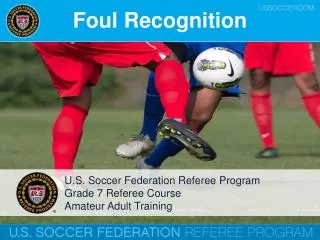
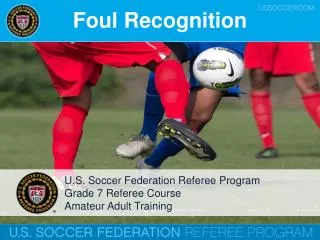
Foul Recognition U.S. Soccer Federation Referee Program Grade 7 Referee Course Amateur Adult Training
Environment • Players • Experienced • Physical • Foul recognition • Game control • Player expectations and respect • Player management
Fouls • Requirements • Committed by a player • On the field of play • While the ball is in play • Against an opponent
Factors • Positioning • Don’t chase the ball • Be aware of passing lanes • Read the game • Game flow • Team tactics • Area of focus • Body areas making contact
Factors • Challenging for the ball • Slide tackles • Gain or deny position • Aerial challenges • Set pieces • Tactical • Breaking up promising attack • Denying advantage
Factors • Frustration • Embarrassed • Retaliation • Vigilante justice • Intimidation • Physical and mental • Attempt to injure • Tactical/Denying a goal scoring opportunity
Evaluation • Speed and distance • Nature of the contact • Challenging for the ball • Temperature of the game
Speed • Effects of increased Speed • More forceful challenge • Less control over body and actions • Reckless • Excessive force
Contact • Nature of the contact • Location • What was the nature of the challenge? • Careless • Reckless • Excessive force
Ball • Challenging for the ball • Timing • Was the ball within playing distance? • Direction of the tackle • Front • Side • Behind
Temperature • Temperature of the match • Game flow • Game control • What has been allowed up to this point? • Has this player committed multiple offenses during the game? • Does the game need a stoppage or misconduct to maintain control?
Recognition • Be particularly aware of fouls • Run of play • Set pieces and restarts • Near penalty area
Run of Play • Trifling • Long balls • Tactical • Counterattacks • Breakaways
Set Pieces • Referee’s management skills tested • Common offenses • Holding • Pushing • Encroachment • Goalkeeper contact • Deal with problems before the kick • Information from assistant referees
Near Penalty Area • Desperate tackles vs. Well executed challenges • Contact with the ball and player • Simulation
Review Question • When evaluating fouls, what factors should the referee consider? • Temperature of the match • Speed and distance of the player • Nature of the contact made • All of the above
Review Question • Are trifling fouls those that are simple in nature and don’t have a significant impact on the game? • Yes • No
Review Question • What are the requirements for a foul? • The action is committed by a player • The action if committed on the field of play • The action is committed while the ball is in play • All of the above
Review Question • What are fouls that break up promising attackers referred to as? • Trifling • Tactical • Ticktack • All of the above
Review Question • Is proper positioning important for accurate foul recognition? • Yes • No
Review Question • What are some of the reasons why amateur adult players commit fouls? • Frustration • Intimidation • Retaliation • All of the above