2.4 DEDUCTIVE REASONING
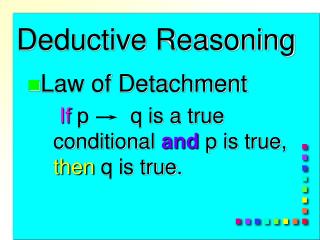
This guide delves into the fundamental concepts of deductive reasoning, focusing on the Law of Detachment and the Law of Syllogism. The Law of Detachment states that if "if p, then q" is true and p is true, then q must also be true. For instance, if a vehicle is a car, then it must have four wheels, and a Cadillac is a car, confirming that it indeed has four wheels. The Law of Syllogism posits that if "if p, then q" and "if q, then r" are both true, then "if p, then r" also holds. Understanding these principles strengthens logical reasoning and problem-solving skills in geometry and beyond.

2.4 DEDUCTIVE REASONING
E N D
Presentation Transcript
2.4 DEDUCTIVE REASONING Playing the game of logic well
Law of Detachment[(p>>q)^p]>>q • If p, then q is True • And p is True • Then q is True • An example: If a vehicle is a car, then it has four wheels. • A Cadillac is a car. • Then (by the law of detachment) it (the caddy) has four wheels.
Law of Syllogism[(p>>q)^(q>>r)] >>(p>>r) • If p, then q is True • And If q, then r is True • Then If p, then r is True • An example: If Gertrude takes the Cadillac for a spin, she will stop at the post office. • If she stops at the post office, then she will buy stamps. • Thus (by the law of syllogism) If Gertrude takes the Cadillac for a spin, then she will buy stamps.
Cornerstone of Geometry • These are two of the laws of logic that provide a system for reaching logical and always true conclusions. • This system is called Deductive Reasoning