SlideServe
Menu
Préférences
© SlideServe · v2026

Efficient Algorithms for Large Parsimony Problems in Phylogenetic Tree Construction

imelda avatar
15 diapositives · 273 Views · Sep 18, 2014

This document reviews the implementation of algorithms for determining the minimum evolutionary cost of sequence datasets in phylogenetic trees, focusing on the NP-Hard nature of the large parsimony problem. It covers methods such as Exact Search, Branch and Bound, and Heuristic Searches, emphasizing their practicality and limitations. Tree creation methods and available software tools like Mega4, PAML, and PHYML are discussed, illustrating how they facilitate sequence alignment and phylogenetic tree estimation.
Efficient Algorithms for Large Parsimony Problems in Phylogenetic Tree Construction - slide 1
01 / 15Efficient Algorithms for Large Parsimony Problems in Phylogenetic Tree Construction
1 / 17

Télécharger la présentation

Efficient Algorithms for Large Parsimony Problems in Phylogenetic Tree Construction
Une image / un lien ci-dessous est fourni (tel quel) pour télécharger la présentation

Politique de téléchargement : le contenu du site vous est fourni TEL QUEL pour votre information et votre usage personnel ; il ne peut être vendu, concédé sous licence ni partagé sur d’autres sites sans l’accord de son auteur.Le contenu vous est fourni TEL QUEL, pour votre information et votre usage personnel uniquement. Téléchargez la présentation en cliquant sur ce lien. Lors du téléchargement, si vous ne parvenez pas à télécharger une présentation, l’éditeur a peut-être supprimé le fichier de son serveur.Pendant le téléchargement, si vous ne parvenez pas à obtenir une présentation, le fichier a peut-être été supprimé par l’éditeur.

F I N

Plus de contenu associé

Transcription de la présentation
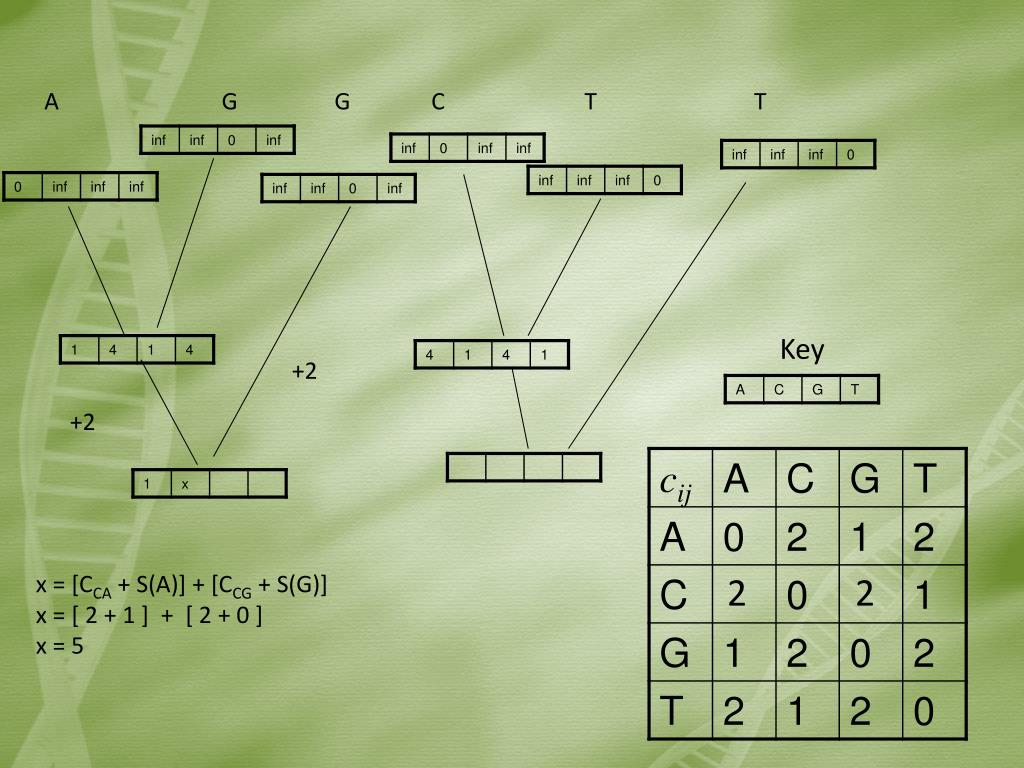
  1. A G G C T T Key +2 +2 x = [CCA + S(A)] + [CCG + S(G)] x = [ 2 + 1 ] + [ 2 + 0 ] x = 5 2 2

  2. A G G C T T

  3. Sankoff Summary • The algorithm is run on all the sites in the sequences • The result is the minimal cost for evolution of the data set on the tree S1 ACCCCTTC S2 ACCCCATA S3 ACTGCTTC S4 ACTGCTAA

  4. Large Parsimony Problem • Finding the parsimony of several sequences considered an NP-Hard problem. • NP-Hard is used for credit card encryption • Calculations for 10 species requires more than 20 million trees. (20 species = 2.2E1020) • Fitch/Sankoff must be run on each tree

  5. Tree Searching Methods • Exact Search • Precise, but for very small trees • Branch and Bound • Precise up to ~20 taxa • Heuristic Searches • Not precise, but allows larger inputs

  6. Exact Search

  7. Branch and Bound • Similar to Exact Search • Adds branches one at a time • Only follows paths with a parsimony score lower than the global score

  8. Branch and Bound • Following the left sub tree gives us a global minimum of 9 • Middle Branch can be ignored • Following the right sub tree finds the optimal solution

  9. Heuristic Searching • Is not guaranteed to find the optimal solution • Finds the optimal sub tree solution • Local peak phenomenon • Methods include: • Star Decomposition • Nearest Neighbor Interchanges • Subtree Pruning and Regrafting

  10. Star Decomposition • The graph can be represented in star form • Each leg is lengthened • Each new graph is scored and the lowest parsimony is selected • The remaining edges are expanded

  11. Nearest Neighbor Interchanges • Removes an internal edge and reconnects the split sub trees • Calculates the parsimony of the resulting graph

  12. Tree Pruning and Regrafting Select a random edge Remove the edge from the graph Select another edge in the remaining graph Add the severed nodes back into the graph at that location Calculate the new parsimony scores

  13. Summary • Tree Creation Methods • Evolutionary Scoring • Precise Searches • Heuristic Searches

  14. Available Software • Mega4 • Elegantly handles downloading sequences, aligning them and then estimating and drawing phylogenetic trees • PAML • A package containing many tree construction and data analysis tools • PHYML • Useful for estimation of Maximum Likelihood trees • MrBayes • Used for Bayesian Inference of phyloenetic trees

  15. Demonstration!