Understanding Circulation and Gas Exchange in Animals
This chapter focuses on the exchange of materials and circulation systems in animals. It discusses the mechanisms of diffusion in simple and complex animals, the open and closed circulatory systems, circulation in humans, variations in different animal groups, respiratory surface adaptations, and gas exchange in humans. The text explores how gas exchange occurs, the role of different phylums in gas exchange, and the process of respiration in aquatic organisms. Additionally, it covers the anatomy and functionalities of the circulatory system in various animals.

Understanding Circulation and Gas Exchange in Animals
E N D
Presentation Transcript
Chapter 42 Notes Circulation and Gas Exchange
Exchange of Materials • Simple animals with few cell layers can operate by diffusion alone. -Cnidarians take in materials into their gastrovascular cavity and material diffuse outward.
Animals with many cell layers require more than a branching gastrovascular cavity. • Open circulatory system • Absence of vessels • No distinction between blood and other fluids (hemolymph) • Drawn into heart through ostia • Pumped out into spaces surrounding organs
Closed Circulatory System • Presence of vessels • Some annelids, mollusks, and vertebrates
Circulation in Humans • Arteries • Large vessels found near the aorta of the heart. • Are able to receive high pressure bursts of blood from the heart. • Arterioles -Smaller and less muscular than arteries. • Capillaries • Smallest blood vessels. • Their walls are often only one cell thick with no muscle. • Allow gases to pass in and out of the blood stream.
Venules • Have a porous wall (containing holes) that allows fluids and white blood cells to pass through. • White blood cells will gather on damaged tissues causing inflammation. • Veins • At any given time, they contain 65% of the body’s blood. • Contain some muscle. • Have valves that prevent blood from flowing backward.
Variations in Animals • Fish Circulation • One atrium, one ventricle • Single circuit between gill and systemic capillaries
Amphibian Circulation • Two Atria, one ventricle • Two circuits (double circulation) 3. Pulmocutaneous-from heart to skin and lungs • Systemic-to capillary beds of the body
Mammalian Circulation • Crocodiles, birds, mammals • Two atria, two ventricles • Two circuits • Pulmonary • Systemic • To electrochemical locations • Pacemaker -sinoatrial node (SA) -located on anterior end of right atria -innervates both atria • Atrioventricular node (AV) -stimulates both ventricles -stimulated by SA node
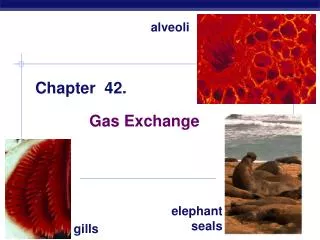
Variation in Respiratory Surfaces • Gas exchange occurs via diffusion (influenced by pressure) • Ideal tissues must be • Thin • Moist • Have large surface area • Phylums Porifera and Cnidaria -Exchange occurs throughout the entire surface
Phylums Platyhelminthes and Annelida • Exchange occurs at skin • Utilize hemoglobin • Phylum Arthropoda • Gas enters through spiracles • Passes through system of tracheal tubes • Arthropods and Mollusks use hemocyanin -Copper in place of Iron
Aquatic Organisms • Exchange takes place via gills • Utilize countercurrent exchange
Gas Exchange in Humans • Air passes through Pharynx Larynx Trachea Bronchi Bronchioles Alveolar Sacs • Drawn in by negative pressure 3. Medulla monitors pH