ECHO: NASA's Centralized Metadata Repository for Earth Science Data
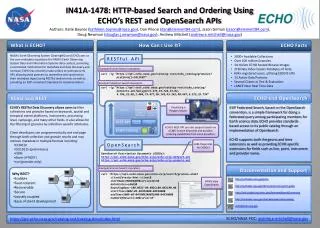
The Earth Observing System ClearingHOuse (ECHO) is NASA’s core repository for metadata and data from its Earth Observing System Data and Information Systems. ECHO provides centralized access to over 120 million granules and 3,500+ collections, enabling efficient data discovery and retrieval through its RESTful API and OpenSearch implementation. The platform supports multiple standards and allows users to perform federated searches for datasets using spatial, temporal, and keyword constraints. With over 78,000 registered users, ECHO is essential for accessing NASA's vast data resources.

ECHO: NASA's Centralized Metadata Repository for Earth Science Data
E N D
Presentation Transcript
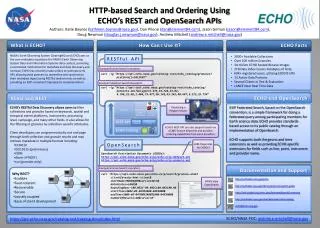
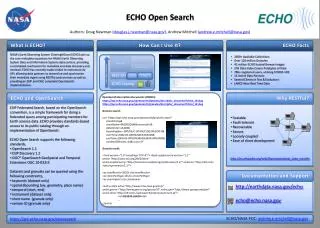
Reverb • Mirador • Giovanni • … Client Data Retrieval ECHO Open Search • Open Search • Searching • Ordering • Multi-format Retrieval • ECHO10 • ISO 19115 • REST API Authors: Doug Newman (douglas.j.newman@nasa.gov), Andrew Mitchell (andrew.e.mitchell@nasa.gov) • ECHO Catalog What is ECHO? How Can I Use It? ECHO Facts NASA’s Earth Observing System ClearingHOuse (ECHO) acts as the core metadata repository for NASA’s Earth Observing System Data and Information Systems data centers, providing a centralized mechanism for metadata and data discovery and retrieval. ECHO hasrecently made strides to restructure its API; allowing data partners to streamline and synchronize their metadata ingest using RESTful web services as well as providing an ESIP and OGC compliant OpenSearch implementation. • 3500+ Available Collections • Over 120 million Granules • 41million ECHO hosted Browse Images • 2TB Data Index Covers Petabytes of Data • 78K+ registered users, utilizing EOSDIS URS • 13 Active Data Partners • Several Clients in Test & Evaluation • LANCE Near Real Time Data ECHO and OpenSearch OpenSearch Description Documents (OSDDs): https://api.echo.nasa.gov/opensearch/datasets/descriptor_document?client_id=dug https://api.echo.nasa.gov/opensearch/granules/descriptor_document?client_id=dug Granule search: curl "https://api.echo.nasa.gov/opensearch/granules.atom? clientId=dug& shortName=MOD02QKM&versionId=5& dataCenter=LAADS& boundingBox=-180.0%2C-90.0%2C180.0%2C90.0& startTime=2002-05-04T03A00-04%3A00& endTime=2009-05-04T00%3A00%3A00-04%3A00& numberOfResults=10&cursor=0” Granule result: <?xml version="1.0" encoding="UTF-8"?> <feed esipdiscovery:version="1.2" xmlns="http://www.w3.org/2005/Atom" xmlns:esipdiscovery="http://commons.esipfed.org/ns/discovery/1.2/" xmlns:os="http://a9.com/-/spec/opensearch/1.1/"> <os:totalResults>50321</os:totalResults> <os:itemsPerPage>10</os:itemsPerPage> <os:startIndex>1</os:startIndex> <entry xmlns:echo="http://www.echo.nasa.gov/esip" xmlns:georss="http://www.georss.org/georss/10" xmlns:gml="http://www.opengis.net/gml" xmlns:time="http://a9.com/-/opensearch/extensions/time/1.0/"> <id>G19324-LAADS</id> … </entry> Why RESTful? • ESIP Federated Search, based on the OpenSearch convention, is a simple framework for doing a federated query among participating members for Earth science data. ECHO provides standards-based access to its public catalog through an implementation of OpenSearch. • ECHO Open Search supports the following standards, • OpenSearch 1.1 • ESIP Discovery 1.2 • OGC® OpenSearch GeoSpatial and Temporal Extensions OGC 10-032r3 • Datasets and granules can be queried using the following constraints, • keywords (dataset only) • spatial (bounding box, geometry, place name) • temporal (start, end) • instrument (dataset only) • short name (granule only) • version ID (granule only) • Scalable • Fault-tolerant • Recoverable • Secure • Loosely coupled • Ease of client development • http://en.wikipedia.org/wiki/Representational_state_transfer Documentation and Support • http://earthdata.nasa.gov/echo • echo@echo.nasa.gov https://api.echo.nasa.gov/opensearch ECHO/NASA POC: andrew.e.mitchell@nasa.gov