Understanding Density: Mass and Volume Relationship Explained
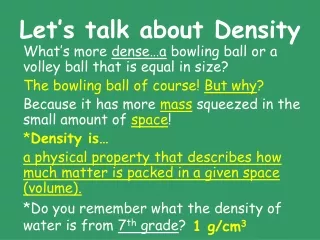
This guide covers the fundamentals of density, mass, and volume. Density refers to the amount of matter (mass) in a given space (volume) and is not affected by gravity. Mass is measured using balances, while volume can be calculated using dimensions (L x W x H or mL via graduated cylinders). The density formula is Density = Mass/Volume, with units in g/mL or g/cm³. Notably, the density of water is 1 g/mL, and substances with lower or higher densities will float or sink, respectively. Temperature also impacts density, making warmer substances less dense and cooler ones more dense.

Understanding Density: Mass and Volume Relationship Explained
E N D
Presentation Transcript
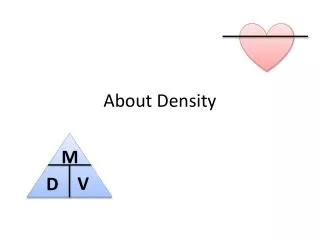
About Density M V D
Mass • The amount of matter in an object • Not affected by gravity • Measured with: triple beam balance or electronic balance • Units: grams (g)
Volume • The amount of space an object takes up • Measured with: • L x W x H = cm3 • Graduated cylinder = mL • Water displacement method = mL • Volume changes with temperature • Cooler = less volume • Warmer = more volume
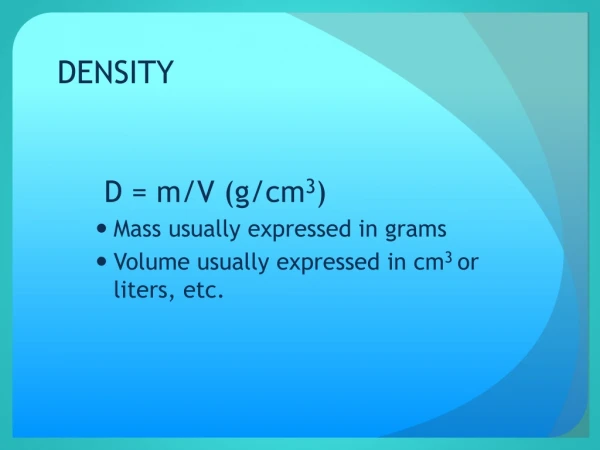
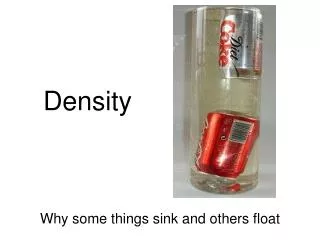
DENSITY • The relationship between mass and volume • Density = Mass Volume • Physical property • Units: g/mL or g/cm3 • Density of water = 1 g/mL • Density < 1 = floats • Density > 1 = sinks • Density changes with temperature • Warmer = less dense = rises • Cooler = more dense = falls M V D