Understanding Business Logic Attacks: Detection and Mitigation Strategies
280 likes | 396 Vues
This presentation addresses the challenges posed by Business Logic Attacks (BATs) and Business Logic Bots (BLBs), exploring the thin line between legitimate automation and malicious activity. It outlines various forms of business logic attacks, such as brute force attempts, denial of service, and automation misuse in e-commerce and service platforms. It emphasizes the importance of both detection and mitigation strategies, discussing tools for effectively identifying unauthorized automation and implementing measures to reduce attack impact while maintaining application integrity.


Understanding Business Logic Attacks: Detection and Mitigation Strategies
E N D
Presentation Transcript
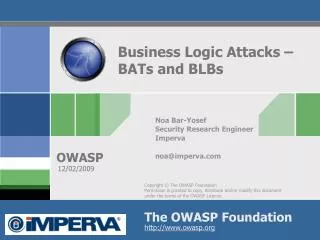
Business Logic Attacks – BATs and BLBs Noa Bar-Yosef Security Research Engineer Imperva noa@imperva.com 12/02/2009
Agenda • The challenge of business logic bots • Business logic attacks • Business process automation: • The friendly side of web automation • Business logic bots: • Malicious web automation • Solutions • Detection • Mitigation
Business Logic Attacks (BATs) Compared to syntactic attacks:
Web Automation • The fact is that web automation is in wide use • Online form automation • Tracking competition • Personal and institutional stock trading • Indexing services • Comparative shopping • Web Services and other web APIs • Bottom line is that business level automation may or may not be defined as an attack based on the context of things • Who is the source • Which part of the business logic is being invoked
Born to be bad: Business Logic Bots (BLBs)
What BLBs Are Used For • Brute force • Cracking login credentials • Guessing session identifiers, file and directory names • Denial of Service • Locking resources • Abusing resource-sensitive functions • Web Spam • Abusive SEO • Comment Spam • Click Fraud • Referrer click fraud. • CSRF click fraud
Hardcore Robotics • Queue Jumping • Ticketmaster confessed to “fighting like the dickens“ queue jumping. • Travel agents known to automate air line ticketing systems. • Auctions Sniping • Watching a timed online auction and placing a winning bid at the last possible moment giving the other bidders no time to outbid the sniper. • Poll Skewing
Gaming Bots • MUD, Virtual Worlds & Second Life bots: • Gain Wealth, and turn it into money in Second Life. • Scripted Clients • GUI Bots • Poker Bots: • Share information between several bots at one table. • Monitor tables to choose the weak ones. • Play well.
Information Harvesting • Harvests: • E-mail and personal information • Competitive information • Record oriented information such as CVs • Entire Web sites for creating a mirror • Executed from: • Local computer • Distributed, potentially using bot net • Trojans, exploiting the victims credentials at the site
Solutions • The solution is comprised of two separate problems • Detection • Mitigation • Detection • Detect automation (absolute) • Flag unauthorized use of automation (subjective) • Mitigation • Effective • Does not break application
Detection – Basic Tools • Black listing: • IP Addresses (IP Reputation) – Anonymous Proxies, TOR exit nodes, highly active bots • User Agents • Ad-hoc attack vector patterns • Ad-hoc comment spam patterns • Request structure • Missing / mismatch Host header • Irregular header combinations • Naïve, but eliminates the masses
Detection – Proactive Techniques • Introduce extra content into the response • The extra content is interpreted in a different manner by a human driven browser and by an automated tool • Must not affect visuals • Must not break application • Positive detection • Extra content affects a robot but not human • Negative Detection • Extra content affects a browser but not a robot
Detection – Frequency Measurement • Count the frequency of “events” within some scope in a given time frame • Challenges • What’s an event? • What’s the best scope? • What’s the right threshold? • Allow detection of script related attacks and brute force attacks
Detection – Flow • Some attacks, either inherently or for performance reasons bypass normal application flow • Traversing a product catalog • Skipping transaction validation • Not easy to implement • Referer header can be forged • Flows are hard to define and track in modern applications that use frames and AJAX • Require guided configuration and learning algorithms • Can detect some types of forceful browsing and man in the browser attacks
Detection – Click Rate • Humans take time to respond (even the fast ones) • Some observations: • Clickable events, within a session, need to be at some minimal distance from one another • Within a session, over time, clickable events should be relatively slow • Can detect general script attacks as well as man in the browser attacks
Detection - Summary • Will a single method do the trick? • I don’t think so. • Will there be false positives? • Yes! • Do I care? • No! Let me tell you why…
Mitigation • Attacks are automated • I can’t prevent the attack from going on • I can however try to “defuse” its effects • Examples: • Slow down a brute force attack • Reduce the rate of a DDoS attack • Make the victim aware of a man-in-the-browser attack • Enforce flow on transactions • Disinformation • Preventative measures may increase the cost of automation to the level that makes it much less attractive for anything but high end targets
Mitigation - Blocking • Dropping requests can only occur in very specific cases • IP blacklists • User-agent blacklists • Strongly enforced flow (e.g. through nonce in a form) • Dropping requests that fail to answer the challenges described in the following slides
Mitigation – That Which Makes Us Human • Provide a Turing test that only a human can solve. • Usually called CAPTCHA. Traditionally character recognition • Other methods exists • Choose the correct description of an image • Solve a simple riddle John had one thousand apples and five oranges. He ate as many of his apples as there is letters in word "apple". Also he ate two bananas :-). How many apples does John have?
Mitigation – That Which Makes Us Human • There are automated tools and algorithms today that solve CAPTCHA’s of various types • I don’t care • If a brute force login program solves one CAPTCHA per second then it is ineffective • If a client solves a CAPTCHA faster than a human being (no less than one second) then it can easily be identified as a robot and further challenged (see next slide)
Mitigation – Throttling • Slowing down an attack is most often the best way to make it ineffective. • A second of delay can make the difference for an automated attack but will not be noticed by most humans • Server side throttling may have sever impact on server (quickly consume connection resources) • Client side computational challenges • Client is required to solve a computational challenge that can be easily verified by server • Code for solving the challenge is introduced into the response in the form of a script
Mitigation – Adaptive Authentication • When automation is detected in the context of a user (man in the browser) • Ask for additional authentication • Repeat password • Previously recorded questions • Makes the attack apparent to a victim
Mitigation - Disinformation • Feed the client with bogus information • A client follows a hidden link • Respond to the request with a page that includes a large number of server distinguishable random links • Whenever one of the random links is requested generate yet another random page • A client that follows a hidden link that was generated by a script • Respond with a page that includes a script that runs for a long time before generating a new random link
Mitigation - Summary • Mitigation methods should take into consideration the possibility of false positives • Most often the system’s reaction to a suspected automation attempt should not be blocking but rather challenging the client • Legitimate clients are not materially affected • Automated clients become ineffective
Summary • Automated business layer attacks are proliferating today and expected to grow in number and sophistication in the near term • Detecting and mitigating these attacks require a set of sophisticated tools that are different than the standard web application security tools • Some of the issues have nothing to do with the way the application code is written • It’s bound to be a cat and mouse game as robots become more sophisticated • As a consequence of the above, solutions should be external to the application code