Advancements in Tuner Design and Testing for 1.3 GHz Cavities
This report details the planning and milestones for the development of a new tuner design for 1.3 GHz b=1 cavities. Key activities include finalizing tuner design by the end of 2005, construction and testing by mid-2006, and ongoing assessments of cavity performance. The report examines the integration of fast LFD action, the influence of mechanical boundary conditions, and presents findings from tests at Saclay and JLAB. Additionally, it discusses tuning requirements for optimal cavity performance in high-gradient applications.

Advancements in Tuner Design and Testing for 1.3 GHz Cavities
E N D
Presentation Transcript
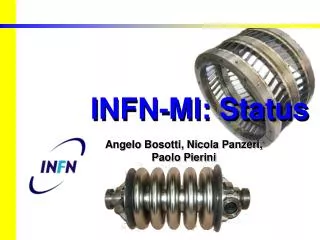
INFN-MI: Status Angelo Bosotti, Nicola Panzeri, Paolo Pierini
Planning • Milestones : • Report on final tuner design by end 2005 • Tuner construction and testing by mid 2006 • Parallel “historical” tuner activity • Started within TTF, now ILC/XFEL • In CARE/JRA1/WP8 • Report in preparation for 1.3 GHz b=1 cavities (Angelo Bosotti) HIPPI05
Displ Stroke Piezo Structure dmax Force Fmax LFD compensation at high gradients (Dn = KL E2) Evolution of the tuner concept, with integration of the fast LFD action 1.3 GHz system under fabrication right now HIPPI05
Cavity A characterization Previous estimation [7 Hz/(MV/m)2] only on half-cell geometry, but also, mechanical load condition was overestimated by a factor of 2. Present calculation on the full geometry. HIPPI05
Where did we stand in tests with cavity A? • Vertical tests: 3 at Saclay, 3 at JLAB Huge spread in static measurements! And off by a factor 10 HIPPI05
Influence of boundary conditions • Linear superposition of 2 effects: • Shape deformation (fixed boundary) • Cavity shortening (cavity+boundary combined stiffness) Analytical derivation of full behavior requires solution of only 2 load cases HIPPI05
Cavity frequency response under arbitrary b.c. • Frequency response of the cavity can be then understood as a function of the external boundary condition • Using values from the cavity mechanical characterization and Slater perturbation theorem HIPPI05
The RF test frames Jlab tests in 2003/2005 Saclay tests in 2004 Q: Are they sufficiently stiff? HIPPI05
JLAB frame • Cavity is held at He tank disks with a bar • Dish stiffness is greatly reduced! HIPPI05
Saclay frame A: NO, both are not stiff enough HIPPI05
Mechanical models assume perfect joints and no slack contacts between components In reality: joints, screws, etc. Correlation with measured KL HIPPI05
Alternative check • From the Saclay data at low temperatures (2.2 to 1.7 K, where the bath pressure is more stable), an average value of Dn/DP of -462 Hz/mbar can be evaluated • Kext of 1.15 kN/mm can be estimated, coherent with the model discussed before • From the JLab data an average of Dn/DP of -1020 Hz/mbar in the same temperature range can be estimated. • Comparable to a nearly “free” cavity behavior (nominal -966 Hz/mbar), with a negligible external stiffness condition with respect to the cavity stiffness, again, coherent with the model discussed before HIPPI05
Summary on static KL • RF test data is understood • Weak constraints for the cavity length • Low beta geometry very sensible to external boundary condition (low cavity stiffness) • Behavior of KL agains Kext allows to set tuner stiffness requirements under operating conditions • Interaction with CEA (GD) has shown a nearly perfect agreement of static LFD modeling • both calculation modes based on Slater perturbation theorem, but different and independent implementations, especially concerning the mechanical part of the codes (ANSYS vs CASTEM) • Planning for dynamic LFD calculations • harmonic analysis + Slater for cavity transfer function and piezo tf • time dependent analysis: overelongation? • need time for the development and check the procedures HIPPI05
Requirements for 704.4 MHz • One of the uncertainties of the piezo materials is still their stroke capabilities at the low operating temperatures • Assuming a 3 mm stroke to cavity (long piezos) • [safe? SRF/WP8 work in progress] • a ~1000 Hz frequency offset can be compensated during the fast tuning action • With a design accelerating field of 8.5 MV/m, this implies that the overall KL in the operating condition should be limited to around -10 Hz/(MV/m)2 • We took a 50% margin for dynamic LFD? [M.Liepe: factor 2] • In order to achieve this condition with these rather soft cavities the combined stiffness of the He Tank and tuner system needs to provide ~ 10 kN/mm • At 20 kN/mm we are hitting limit with He tank dish stiffness HIPPI05
Tuner requirements • Extracting out the Tank and end dish stiffness contribution (total of 15 kN/mm), the requirement for the tuner becomes about 20 kN/mm Actual experimental stiffness including leverage (TTF) HIPPI05
On the road to finalize tuner design Now we are fine-tuning the tuner stiffness by slight adjustments of the blade number length and slope for final optimization before emitting final drawings for Cavity A Will ask for bids in late 2005 and Order main tuner mechanical components before end of year (INFN contribution is available) Then fabrication time will take 4-6 months HIPPI05