SlideServe
Menu
Préférences
© SlideServe · v2026

Understanding Chemical Reactions and Balancing Equations Method

iona-cleveland avatar
11 diapositives · 247 Views · Nov 05, 2014

Learn the rules and steps for balancing chemical equations, conserve mass, and balance equations with coefficients. Practice balancing chemical equations with examples and understand endothermic and exothermic reactions.
Understanding Chemical Reactions and Balancing Equations Method - slide 1
01 / 11Understanding Chemical Reactions and Balancing Equations Method
1 / 17

Télécharger la présentation

Understanding Chemical Reactions and Balancing Equations Method
Une image / un lien ci-dessous est fourni (tel quel) pour télécharger la présentation

Politique de téléchargement : le contenu du site vous est fourni TEL QUEL pour votre information et votre usage personnel ; il ne peut être vendu, concédé sous licence ni partagé sur d’autres sites sans l’accord de son auteur.Le contenu vous est fourni TEL QUEL, pour votre information et votre usage personnel uniquement. Téléchargez la présentation en cliquant sur ce lien. Lors du téléchargement, si vous ne parvenez pas à télécharger une présentation, l’éditeur a peut-être supprimé le fichier de son serveur.Pendant le téléchargement, si vous ne parvenez pas à obtenir une présentation, le fichier a peut-être été supprimé par l’éditeur.

F I N

Plus de contenu associé

Transcription de la présentation
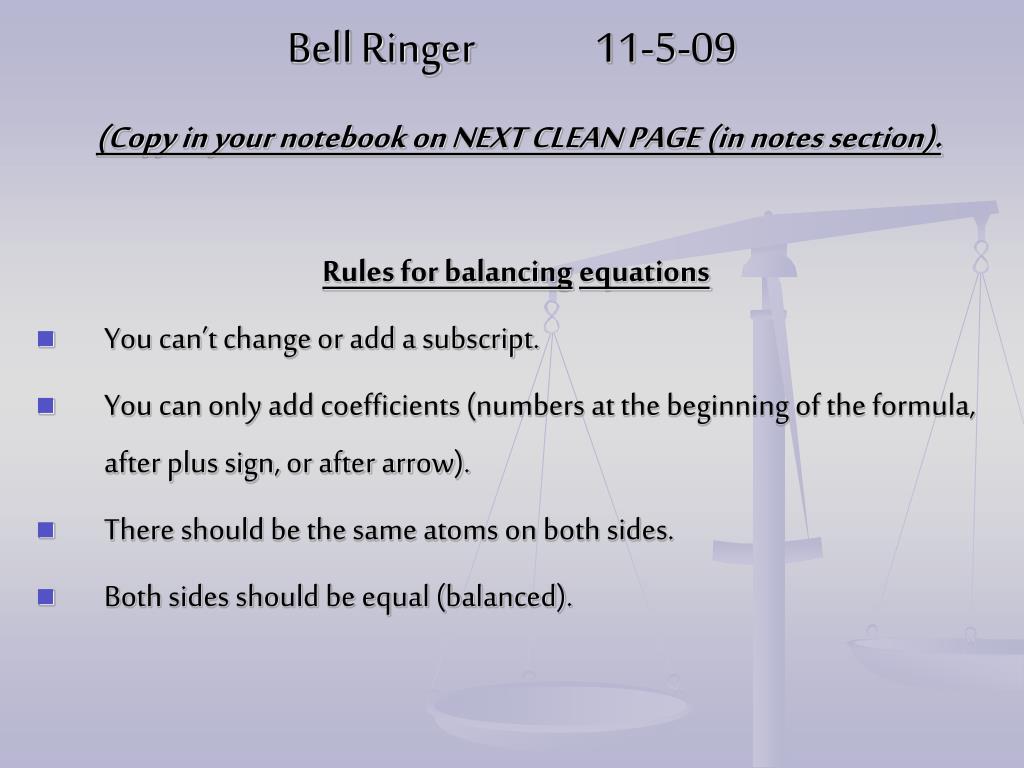
  1. Bell Ringer 11-5-09 (Copy in your notebook on NEXT CLEAN PAGE (in notes section). Rules for balancingequations • You can’t change or add a subscript. • You can only add coefficients (numbers at the beginning of the formula, after plus sign, or after arrow). • There should be the same atoms on both sides. • Both sides should be equal (balanced).

  2. ALCOS Objectives: • #1- Identify the steps of the scientific method • #4 State the law of conservation of matter (Balancing Chemical Equations)

  3. Chapter 6 Section 2 :Describing Chemical Reactions

  4. Chemical Equations • Use chemical formulas and other symbols instead of words to summarize a reaction.

  5. Conservation of Mass • The principle of conservation of mass states that in a chemical reaction, the total mass of the reactants must be equal to the total mass of the product.

  6. A Balanced Chemical Equation Same numbers of each type of atom on each side of the equation. Al + S Al2S3 Not Balanced 2Al + 3S Al2S3Balanced

  7. Balance Equations with Coefficients Coefficients in front of formulas balance each type of atom. 4NH3 + 5O24NO + 6H2O 4 N = 4 N 12 H = 12 H 10 O = 10 O

  8. Steps in Balancing An Equation Fe3O4 + H2 Fe +H2O Fe:Fe3O4 + H23 Fe +H2O O:Fe3O4 + H2 3 Fe +4H2O H: Fe3O4 + 4 H2 3 Fe +4H2O

  9. Endothermic energy – heat energy being absorbed. Ex. Baking something Exothermic energy – heat energy is being released. Ex. Burning something

  10. Let’s Try These…Balance these equations • Fe + H2O → Fe3O4 + H2 • C + H → CH4 • Zn + Ag2S → ZnS + Ag • Ag2O → Ag + O2 • Cl2 + NaBr → NaCl + Br2 • K2CO3 + CaCl2 → CaCO3 + KCl • AgNO3 + NaI → AgI + NaNO3