SlideServe
Menu
Préférences
© SlideServe · v2026

crystal

iris-campos avatar
23 diapositives · 507 Views · Nov 02, 2014

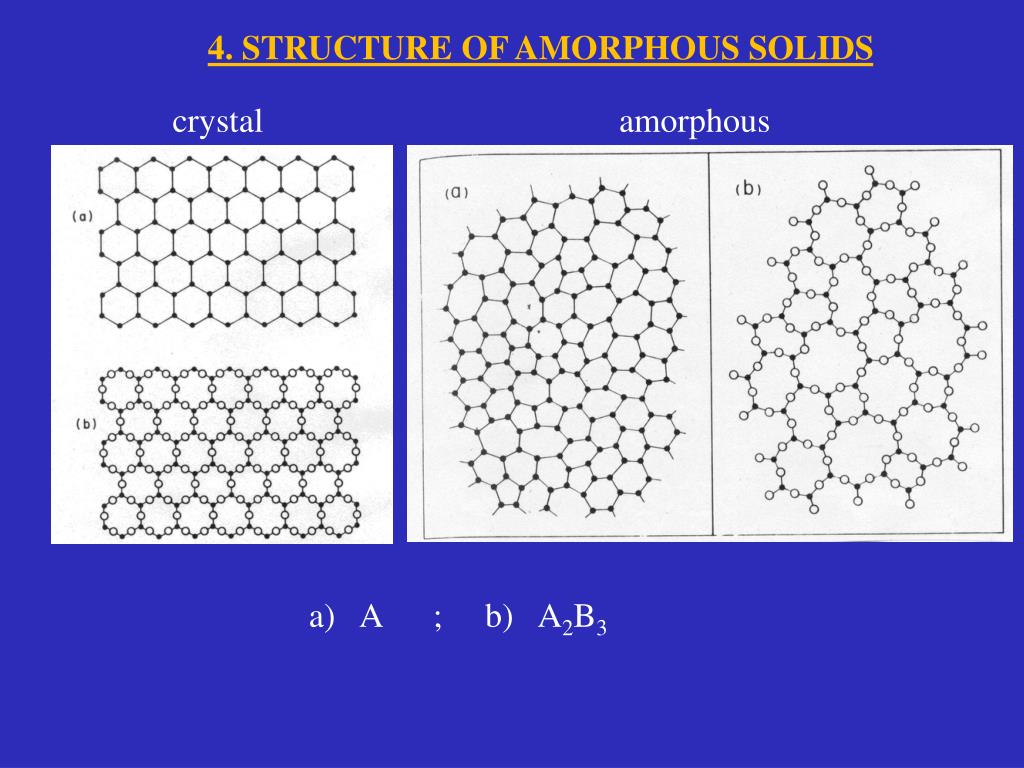
4. STRUCTURE OF AMORPHOUS SOLIDS. crystal. amorphous. a) A ; b) A 2 B 3. coordination number z gives some hints: A low coordination number ( z = 2, 3, 4 ) provides evidence for a dominant role of covalent bonding (SiO 2 , B 2 O 3 …)
crystal - slide 1
01 / 23crystal
1 / 17

Télécharger la présentation

crystal
Une image / un lien ci-dessous est fourni (tel quel) pour télécharger la présentation

Politique de téléchargement : le contenu du site vous est fourni TEL QUEL pour votre information et votre usage personnel ; il ne peut être vendu, concédé sous licence ni partagé sur d’autres sites sans l’accord de son auteur.Le contenu vous est fourni TEL QUEL, pour votre information et votre usage personnel uniquement. Téléchargez la présentation en cliquant sur ce lien. Lors du téléchargement, si vous ne parvenez pas à télécharger une présentation, l’éditeur a peut-être supprimé le fichier de son serveur.Pendant le téléchargement, si vous ne parvenez pas à obtenir une présentation, le fichier a peut-être été supprimé par l’éditeur.

F I N

Plus de contenu associé

Transcription de la présentation
  1. 4. STRUCTURE OF AMORPHOUS SOLIDS crystal amorphous a) A ; b) A2B3

  2. coordination number z gives some hints: • A low coordination number (z = 2, 3, 4) provides evidence for a dominant role of covalent bonding (SiO2, B2O3…) • More “closed-packed” structures are symptomatic of non-directional forces (ionic, van der Waals, metallic bonding…): z(NaCl)=6, z(Ca)=8, z(F)=4 … • fcc or hcp structures are typical of metallic crystals AB forming a close-packed lattice with z=12, the extreme of maximum occupation.

  3. RDF Radial Distribution Function J(r) = 4 r 2 (r)

  4. RDF J (r) = 4 r 2 (r)

  5. 3 main kinds of atomic-scale structure (models) of amorphous solids: • Continuous Random Network  covalent glasses • Random Close Packing  simple metallic glasses • Random Coil Model  polymeric organic glasses

  6. Amorphous Morphology: Continuous Random Network. crystals amorphous a) A ; b) A2B3 Continuous Random Network (Zachariasen, 1932)

  7. Amorphous Morphology. Amorphous Morphology: Continuous Random Network. - coordination number COMMON: - (approx.) constant bond lengths - ideal structures (no dangling bonds…) DIFFERENT: - significant spread in bond angles - long-range order is absent

  8. Review of crystalline close packing.

  9. Review of crystalline close packing. Calculate the packing factor for the FCC cell: In a FCC cell, there are four lattice points per cell; if there is one atom per lattice point, there are also four atoms per cell. The volume of one atom is 4πr3/3 and the volume of the unit cell is .

  10. Amorphous Morphology: Random Close Packing There is a limited number of local structures. The volume occupancy is 64%

  11. Amorphous Morphology: Random Coil Model RCM is the most satisfactory model for polymers, based upon ideas developed by Flory (1949, …, 1975). Each individual chain is regarded as adopting a RC configuration (describable as a 3-D random walk). The glass consists of interpenetrating random coils, which are substantially intermeshed – like spaghetti !!!

  12. Basic geometry for diffraction experiments: DIFFRACTION EXPERIMENTS = h c / E I (k) = h / (2·m·E)1/2 k = (4 / ) sen 

  13. Neutron scattering It allows to take data to higher values of k (using smaller wavelengths) and hence reduce “termination errors” in the Fourier transform. Neutrons emerge from a nuclear reactor pile with   0.11 Å Scattering events: Energy transfer: Momentum transfer: Scattering function: