Explore the 3D World of Hamadryas Baboons: Evolutionary Insights and More
Discover the fascinating world of Old World monkeys, specifically the Hamadryas baboon (Papio hamadryas). This interactive 3D model, derived from CT scans, offers a unique view of the skull of specimen USNM A49732, collected by J. L. Buck for the Smithsonian's Division of Mammals. Learn how to manipulate the model for a better understanding of primate evolution. This educational resource, part of a larger initiative to make scientific collections accessible, is available for learning purposes only. For other inquiries, please contact the Human Origins Program.

Explore the 3D World of Hamadryas Baboons: Evolutionary Insights and More
E N D
Presentation Transcript
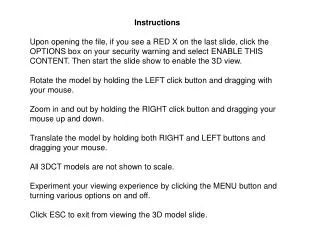
Instructions Upon opening the file, if you see a RED X on the last slide, click the OPTIONS box on your security warning and select ENABLE THIS CONTENT. Then start the slide show to enable the 3D view. Rotate the model by holding the LEFT click button and dragging with your mouse. Zoom in and out by holding the RIGHT click button and dragging your mouse up and down. Translate the model by holding both RIGHT and LEFT buttons and dragging your mouse. All 3DCT models are not shown to scale. Experiment your viewing experience by clicking the MENU button and turning various options on and off. Click ESC to exit from viewing the 3D model slide.
Old World monkeys are primates and are more closely related to humans and apes than any other living nonhuman primate group. The Smithsonian Institution’s Division of Mammals (http://vertebrates.si.edu/mammals/) houses many Old World monkeys in its scientific collections. This specimen, USNM A49732 (http://collections.mnh.si.edu/search/mammals/?irn=7424616), is a Hamadryas baboon (Papio hamadryas). This individual was collected by J. L. Buck and donated to the collection by the Smithsonian National Zoo. This is a CT scan of the cranium of USNM A49732. These three-dimensional scans are made publicly available through the generous support of the Smithsonian 2.0 Fund, provided from the annual gifts of the Smithsonian National Board to the Secretary to use at his discretion (http://smithsonian20.si.edu/fund.html), and the Smithsonian Collections Care and Preservation Fund. The main goal of this joint initiative between the Human Origins Program and the Division of Mammals is to make the NMNH's scientific collections of our closest living nonhuman primate relatives available in 3D for education and research. These slides can be used for educational purposes only. For all other uses, please contact the Human Origins Program at HO-PhotoRequest@si.edu or HumanOrigins@si.edu