Understanding Consistent, Inconsistent, and Dependent Systems of Equations
70 likes | 205 Vues
In this lesson, students will learn to classify systems of equations as consistent, inconsistent, or dependent. A consistent system has at least one solution, with the possibility of lines intersecting or being the same line. An inconsistent system features parallel lines with no solution. A dependent system contains infinite solutions, characterized by equations that are scalar multiples of each other. Through clear examples and slope comparisons, students will develop the necessary skills to analyze various systems in both two-variable and three-variable contexts.


Understanding Consistent, Inconsistent, and Dependent Systems of Equations
E N D
Presentation Transcript
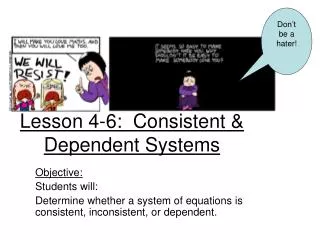
Don’t be a hater! Lesson 4-6: Consistent & Dependent Systems Objective: Students will: Determine whether a system of equations is consistent, inconsistent, or dependent.
Consistent Systems At least 1 solution Two possibilities: 1) Lines intersect 2) Same line Inconsistent system If lines are parallel they are called inconsistent There is no solution to the system Lines have same slope but are not same line (different intercepts)
Dependent System: Infinite number of solutions ►lines that are actually the same ►one equation is a scalar of the other (can multiply by a factor to become the other) How to find consistent systems: (Ones having 1 or more solutions) Compare Slopes ►if they are different ► if they are the same & dependent (same line)
Remember in standard form the slope Example 1 Consistent? x – y = 2 x + y = 4 What is the slope? What is the slope? 1 -1 They do not have the same slope so they are consistent (only one solution) Example 2 Consistent? 2x + y = 4 4x + 2y = 16 What is the slope? What is the slope? -2 -2 Since the slopes are the same we need to determine if they are the same line consistent or parallel lines inconsistent Is one of the equations a scalar of the other? No, if you multiply the top equation by 2 you get 4x +2y =8 so they are not the same line and therefore inconsistent (no solution)
Example 3: Consistent or inconsistent for 3x 3: 1) x + 2y + z =1 2) 3x + 3y + z = 2 3) 2x + y = 2 Multiplying 2) by -1 and adding to 1) yields: -2x – y = -1 Multiplying 3) by -1 yields: -2x –y = -2 What is the slope? -2 What is the slope? -2 Since they have the same slope but are not the same line they are inconsistent
Example 3 Is this system dependent? x – 3y = 2 3x – 9y = 6 If we multiply the top equation by a scalar of 3 we get: 3x - 9y = 6 which is equation 2!! The two lines are the same and the system is dependent (infinite number of solutions) Make sure both equations are in the same form- Either slope-intercept or standard before checking!
3-variable systems Combine 2 equations to eliminate a variable If this new equation is a multiple of the 3rd equation → DEPENDENT Example 4 Dependent? x + y = 1 -x + z = 1 y + z = 2 Which equations are easiest to combine? 1 and 2 to get y + z =2 This is already the 3rd equation!! (scalar of 1) so dependent