Download
1 / 11
110 likes | 224 Vues
This presentation investigates the intriguing phenomenon of quark confinement within protons, delving into the principles of Quantum Chromodynamics (QCD). It examines the unique vacuum state of QCD, which is not empty but filled with short-lived particle pairs, impacting the behavior of quarks and gluons. The study covers the strong interactions mediated by gluons and explores how understanding two-body physics helps illuminate complex n-body systems. Recent experiments, such as those conducted at RHIC, aim to create quark-gluon plasma, offering insights into the fundamental nature of matter at extreme conditions.

E N D
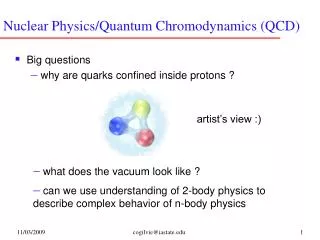
Big questions • why are quarks confined inside protons ? artist’s view :) Nuclear Physics/Quantum Chromodynamics (QCD) • what does the vacuum look like ? • can we use understanding of 2-body physics to describe complex behavior of n-body physics cogilvie@iastate.edu
t z Quantum Chromodynamics (QCD) quark quark quark quark Strong interaction/scattering by exchange of gluons Force between two quarks does not weaken as you separate them Completely counter-intuitive Gravity, electric, magnetic forces all are weaker at larger distances cogilvie@iastate.edu
Confinement: A Partial Answer • Attractive interaction • try to separate quarks, force pulls them back • More complicated …… try to separate quarks narrow “string” or color field / gluons cogilvie@iastate.edu
q q vacuum expels QCD field (gluons), Restricts gluons to be between quarks in “string” q q • Confinement • Attractive force as you try to separate quarks • vacuum expels color field • quarks must stay “outside the vacuum” i.e. inside hadrons! Confinement: The rest of the story “vacuum” is not empty!!, short-lived creation/destruction of particle pairs cogilvie@iastate.edu
Attack QCD on Multiple Fronts: ISU Program • Experiments that push our understanding of strong QCD • Form + study a bulk system of very hot quarks and gluons • Quark-gluon plasma • Melts the vacuum • Detailed study of the quarks, gluons inside a proton • Spin of a proton • Low-momentum region <= high density of gluons cogilvie@iastate.edu
The Quark-Gluon Plasma • In all protons, neutrons, the quarks are confined to radius ~ 1x10-15m • Inside a nucleus, average separation between nucleons is ~ 2x10-15m • Increase density by compression or heating • nucleons significantly overlap • quarks, gluons no longer confined, • QGP : new form of hot, dense matter cogilvie@iastate.edu
BRAHMS PHOBOS PHENIX STAR Long Island RHIC • Two independent accelerator rings • 3.83 km in circumference • Accelerates everything, from p to Au Ös p-p 500 GeV Au-Au 200 GeV cogilvie@iastate.edu
STAR Au on Au Event at CM Energy 130 GeV*A cogilvie@iastate.edu
PHENIX at RHIC • 2 central spectrometers West • 2 forward spectrometers South East North cogilvie@iastate.edu
Silicon Detector Upgrade to PHENIX Two layers of silicon pixel detectors Two layers of silicon strip detectors Tracks extropolate back to collision vertex Displaced vertices => charm (D), beauty (B) Requires ~ 50 mm precision e X De+X Au Au B e+X e X e p0 e+e- cogilvie@iastate.edu
Nuclear Physics @ ISU • Many-body QCD • Experiment and theory • Densest, hottest matter: QGP, RHIC and LHC • Detailed study of the quarks, gluons inside a proton • Strongest gluon field possible in protons+nuclei • Large, active, enthusiastic group • Well-funded • Hardware experience • Exciting physics • Open invitation to join our group cogilvie@iastate.edu