Chapter 15: Neural Integration I: Sensory Pathways and the Somatic Nervous System
1.07k likes | 2.79k Vues
Chapter 15: Neural Integration I: Sensory Pathways and the Somatic Nervous System. Neural Integration. Afferent Division of the Nervous System. Receptors Sensory neurons Sensory pathways. Afferent Division. Sensory receptors sensory pathway Somatic Sensory info


Chapter 15: Neural Integration I: Sensory Pathways and the Somatic Nervous System
E N D
Presentation Transcript
Chapter 15: Neural Integration I: Sensory Pathways and the Somatic Nervous System
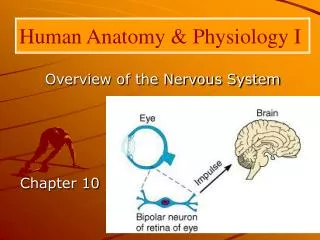
Afferent Division of the Nervous System • Receptors • Sensory neurons • Sensory pathways
Afferent Division • Sensory receptors sensory pathway • Somatic Sensory info • Sensory cortex of cerebrum • Cerebellum • Visceral Sensory info • Reflex centers in brainstem • Reflex centers in diencephalon
Sensory Receptors • Specialized cells that monitor specific conditions in the body or external environment • General Senses: • Temp, pain, touch, pressure, vibration, proprioception • Simple receptors located anywhere on body • Special Senses: • Are located in sense organs such as the eye or ear • Olfaction, vision, gustation, hearing, equilibrium • Complex receptors located in specialized sense organs
Sensory Receptors • Sensation – the sense info; action potentials • Taste, hearing, equilibrium, and vision provided by specialized receptor cells • Communicate with sensory neurons across chemical synapses • Perception – conscious awareness of sensation
Sensory Receptors • Transduction – conversion of environmental stimulus into action potential by sensory receptor • Action potential: • When stimulated, a receptor passes information to the CNS in the form of action potentials along the axon of a sensory neuron • Receptors specific for particular type of stimulus • Specificity is due to structure of receptor • Simplest receptors are dendrites (free nerve endings), least specific
Free Nerve Endings • Branching tips of dendrites • Not protected by accessory structures • Can be stimulated by many different stimuli
Sensory Receptors • Receptive field • area monitored by single receptor (e.g. touch: arm vs. fingertip) • Area is monitored by a single receptor cell • The larger the receptive field, the more difficult it is to localize a stimulus
Sensory Receptors • Labeled line • Link between receptor and processing site in CNS • Stimulation anywhere on labeled line will produce the same perception (e.g. phantom limb) • Stimulus -> receptor -> transduction -> action potential -> sensation ->-> CNS perception
Sensory Pathways • Deliver somatic and visceral sensory information to their final destinations inside the CNS using: • nerves • nuclei • tracts
Sensory Receptors • Tonic Receptors: • Always active • Signal at different rate when stimulated • Monitor background levels • Phasic Receptors: • Activated by stimulus • Become active for a short time whenever a change occurs • Monitor intensity and rate of change of stimulus
Sensory Receptors • Adaptation • Reduced sensitivity to a constant stimulus • Peripheral Adaptation: • Reduction in receptor activity • Phasic fast adapting • Tonic slow or non adapting • Remind you of an injury long after the initial damage has occurred • Central Adaptation: • Inhibition of nuclei along labeled line • Not all pathways will adapt
Four types of General Sensory Receptors • Pain: nociceptor • Temperature: thermoreceptor • Physical: mechanoreceptor • Chemicals: chemoreceptors • All can be found in both somatic (exteroceptors) and visceral (interoceptors) locations except: • Proprioceptors (a mechanoreceptor) are somatic only • report the positions of skeletal muscles and joints
1. Pain Receptors: Nociceptors • Detect Pain • Are common in the: • superficial portions of the skin • joint capsules • within the periosteum of bones • around the walls of blood vessels • Rare in deep tissue and visceral organs • Consist of free nerve endings with large receptor fields Figure 15–2
1. Pain Receptors: Nociceptors • Mode of Action: • Injured cells release arachidonic acid • Arachidonic acid is converted into prostaglandins by the interstitial enzyme cyclo-oxygenase • Prostaglandins activate nociceptors • Many pain medications like aspirin function to inhibit cyclo-oxygenase
1. Pain Receptors: Nociceptors • Once transduced pain sensations are carried on either type A and type C fibers/axons: • Type A: • Fast pain; stab or cut; triggers defensive reflexes • Type C: • Slow pain; aching pain • Tonic receptors with no peripheral adaptation • Pain levels are modulated by endorphins which inhibit CNS function
2. Thermoreceptors • Detect temperature • Found in skin, skeletal muscle, liver, and hypothalamus • Consist of free nerve endings • Phasic receptors that adapt easily
3. Mechanoreceptors **Detect membrane distortion Three receptor types: • Tactile Receptors • Proprioceptors • Baroreceptors
3. Mechanoreceptors • Tactile Receptors • Detect touch, pressure and vibration on skin • Free nerve endings • Detect touch on skin • Tonic receptors with small receptor fields • Root hair plexus nerve endings • Detect hair movement • Phasic receptors, adapt rapidly • Tactile discs/Merkel’s discs • Detect fine touch • Extremely sensitive • Whole cell tonic receptors
3. Mechanoreceptors • Tactile Receptors • Tactile corpuscles/Meissner’s corpuscles • Detect fine touch and vibration • Larger receptor structure • Phasic receptors, adapt rapidly • Lamellated corpuscles/Pacinian corpuscles • Detect deep pressure • Larger multi-layer receptors • Phasic receptor, adapt rapidly • Ruffini corpuscles • Detect pressure and distortion • Large tonic receptors, no adaptation
3. Mechanoreceptors • Proprioceptors: • Detect positions of joints and muscles • Tonic receptors, do not adapt, complex • Muscle spindles • Modified skeletal muscle cell • Monitor skeletal muscle length • Golgi tendon organs • Dendrites around collagen fibers at the muscle-tendon junction • Monitor skeletal muscle tension • Joint capsule receptors - Monitor pressure, tension and movement in the joint
3. Mechanoreceptors • Baroreceptors • Detect pressure changes • Found in elastic tissue of blood vessels and organs of digestive, reproductive and urinary tracts • Consists of free nerve endings • Phasic receptors, adapt rapidly
4. Chemoreceptors • Detect change in concentration of specific chemicals or compounds • E.g. pH, CO2 • Found in respiratory centers of the brain and in large arteries • Phasic receptors, adapt rapidly
KEY CONCEPT • Stimulation of a receptor produces action potentials along the axon of a sensory neuron • The frequency and pattern of action potentials contains information about the strength, duration, and variation of the stimulus • Your perception of the nature of that stimulus depends on the path it takes inside the CNS
Somatic Sensory Pathways • Carry sensory information from the skin and musculature of the body wall, head, neck, and limbs
Somatic Sensory Pathways • Consist of two or three neurons: • First Order Neuron: • Sensory neuron • Connects from receptor to CNS • Cell body is in dorsal root ganglion/cranial nerve ganglion • Second Order Neuron: • Interneuron (stimulated by first order) • Located in spinal cord or brain stem • Subconscious processing of info • Third Order Neuron: • Located in thalamus • Relays info to primary somatosensory cortex of cerebrum for conscious awareness (perception)
Only ~1% of somatic sensory info reaches cerebrum (major changes only, “background” in filtered) • LSD interferes with sensory damping/filtering = sensory overload • All sensory info undergoes decussation in spine before reaching target in CNS
3 Major Somatic Sensory Pathways Figure 15–4
Posterior Column Pathway • Carries sensations of highly localized (“fine”) touch, pressure, vibration, and proprioception Figure 15–5a
Visceral Sensory Pathways • Interoceptors transmit info to solitary nucleus of medulla oblongata for relay to visceral centers in brainstem and diencephalon • No perception • Two neurons: 1st and 2nd order
Efferent Division • Conscious and subconscious motor centers in brain -> motor pathways -> • Somatic Nervous System skeletal muscle • Autonomic Nervous System visceral effectors - Smooth and cardiac muscle, glands, and adipose
Somatic Nervous System • Motor control of skeletal muscle • Consists of two neurons: • Upper motor neuron • Has soma in CNS processing center: • Primary motor cortex of cerebrum - voluntary control • Cerebrum, diencephalon, and brain stem - subconscious control:reflex • Basal nuclei of cerebrum and cerebellum - coordination, balance, fine tuning • Lower motor neuron • Soma in brain stem or spinal cord • Links to skeletal muscle motor unit
Sensory HomunculusFunctional map of the primary sensory cortex Figure 15–5a, b
Processing in the Thalamus • Determines whether you perceive a given sensation as fine touch, as pressure, or as vibration
Motor Related Disorder • Parkinson’s Disease • Jittery movements: lack of fine tuning of motor • Results from degeneration of dopamine neurons of substantia nigra • Inhibits basal nuclei • Overactive basal nuclei = “ticks” • Amylotrophic Lateral Sclerosis • Degeneration of motor neurons in CNS • Causes muscle atrophy and death
Motor Related Disorder 3. Epilepsy • 1/25 people • Wide range in condition: • Absence seizures (blank) to grand mal seizures (convulsions, unconscious) • Uncontrolled/chaotic neuron activity in brain: blocks normal messages
When the nociceptors in your hand are stimulated, what sensation do you perceive? • pain • heat • vibration • pressure
What would happen to you if the information from proprioceptors in your legs were blocked from reaching the CNS? • no pain sensations from the legs • uncontrolled blood pressure in the legs • uncoordinated movements and inability to walk • no tactile sensations in the legs
Chapter 16: Neural Integration II: The Autonomic Nervous System and Higher-Order Functions
Autonomic Nervous System(ANS) • Operates without conscious instruction • Coordinates systems functions: • cardiovascular • respiratory • digestive • urinary • reproductive
Autonomic Nervous System • Motor control of visceral effectors • Involves three neurons: • Visceral motor nuclei in hypothalamus to autonomic nuclei in CNS • Autonomic nuclei to autonomic ganglia in PNS • Autonomic ganglia to visceral effector **Nuclei = in CNS, a center with a visible boundary **Ganglia = in PNS, collection of somas together in one place
Two subdivisions • Sympathetic: “fight or flight” • Parasympathetic: “rest and digest” • Typically oppose each other on same effector • Some effectors innervated by only one: • Blood vessels/sweat glands –> sympathetic only • Smooth muscle of eye –> parasympathetic only