Binary Search Trees Implementation Guide with Linked List and Array
Learn to implement a binary search tree using linked list or array with functions for insertion, deletion, search, traverse, and tree creation. Understand the advantages and disadvantages of both implementations.

Binary Search Trees Implementation Guide with Linked List and Array
E N D
Presentation Transcript
Speed of List Search • O(n) when implemented as a linked-list • O(lg n) possible if implemented as an array
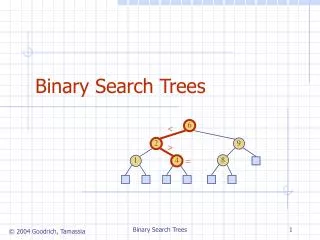
Binary Search Tree 54 21 72 5 30 60 84 10 25 35 79 86 44 93
Binary Search Tree Tree T is a binary search tree made up of n elements: x0 x1 x2 x3 … xn-1 Functions: createEmptyTree() returns a newly created empty binary tree delete(T, p) removes the node pointed to by p from the tree T insert(T, p) returns T with the node pointed to by p added in the proper location search(T, key) returns a pointer to the node in T that has a key that matches key returns null if the node is not found traverse(T) prints the contents of T in order isEmptyTree(T) returns true if T is empty and false if it is not
Homework 4 • Describe how to implement a binary search tree using a set of nodes (this tree will have no number of element limit). • Do the six BST functions. • Can you determine how to implement a binary search tree using an array (assume it will never have more than 100 elements)? • Consider the six BST functions.
Binary Search Tree 54 21 72 5 30 60 84 10 25 35 79 86 44 93
createEmptyTree() t null
isEmptyTree(t) return t == null
search(t, key) search(t, key) if t == null return null else if key == t.key return t else if key < t.key return search(t.left, key) else return search(t.right, key)
search(t, key) t 52 35 80 20 48 65 null 58 70 40 30 10 45 75 15 60
insert(t, p) insert(t, p) if t == null t = p else insert2(t, p) return t
insert2(t, p) insert2(t, p) if p.key < t.key if t.left == null t.left = p else insert2(t.left, p) else if t.right == null t.right = p else insert2(t.right, p)
traverse(t) traverse(t) if t != null traverse(t.left) print t.data traverse(t.right)
delete(t, p) -- leaf t p 52 35 null null
delete(t, p) -- leaf t p 52 35 t.left = null null null null
delete(t, p) – single parent t p 52 35 20 null
delete(t, p) – single parent t p 52 35 t.left = p.left 20 null
delete(t, p) t p 52 35 20 41 46
delete(t, p) t p 52 35 successor 20 41 46
successor(t, p) t 50 36 80 20 48 65 null 58 70 40 30 10 45 75 15 60 39
delete(t, p) t p 52 35 successor 20 41 46
delete(t, p) t p 52 delete(p, successor) 35 successor 20 41 46
delete(t, p) t p 52 t.left = successor 35 successor 20 41 46
delete(t, p) t successor.left = p.left successor.right = p.right p 52 35 successor 20 41 46
delete(t, p) t 50 36 80 20 48 65 null 58 70 40 30 10 45 75 15 60 39
Binary Search Tree -- Array 0 1 11 2 3 4 5 6 7 8 9 10 2 * i + 1 is the left child 2 * i + 2 is the right child
Binary Search Tree -- Array 0 1 11 2 3 4 5 6 7 8 9 10 2 * i + 1 is the left child 2 * i + 2 is the right child
Binary Search Tree -- Array 0 1 11 2 3 4 5 6 7 8 9 10 2 * i + 1 is the left child 2 * i + 2 is the right child
Binary Search Tree -- Array • Advantages • fast • can access the parent from a child • Disadvantages • fixed size
Speed of Binary Search Trees In the worst case a BST is just a linked list. t 20 35 48 52 65 80 O(n) How can we guarantee O(lg n) null
O(lg n) Search Tree Tree T is a search tree made up of n elements: x0 x1 x2 x3 … xn-1 No function (except transverse) takes more than O(lg n) in the worst case. Functions: createEmptyTree() returns a newly created empty binary tree delete(T, p) removes the node pointed to by p from the tree T insert(T, p) returns T with the node pointed to by p added in the proper location search(T, key) returns a pointer to the node in T that has a key that matches key returns null if the node is not found traverse(T) prints the contents of T in order isEmptyTree(T) returns true if T is empty and false if it is not
Homework 5 • Describe how to implement a search tree that has a worst time search, insert, and delete time of no more than O(lg n). This tree should have no number of element limit. • Do the six Search Tree functions. • Discuss how you would implement this if there was a maximum to the number of elements.