Understanding the Periodic Table: Organization and Classification of Elements
The Periodic Table, developed by Russian chemist Dmitri Mendeleev in 1869, is a systematic way to organize and classify chemical elements. Arranged in rows (periods) and columns (groups), it showcases elements by atomic weight. Elements in the same group exhibit similar properties, while those in a period differ significantly. The table categorizes elements into metals, non-metals, and metalloids, highlighting their unique characteristics. This educational tool aids in understanding chemical properties and relationships, facilitating learning through activities like scavenger hunts.

Understanding the Periodic Table: Organization and Classification of Elements
E N D
Presentation Transcript
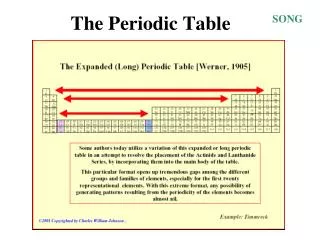
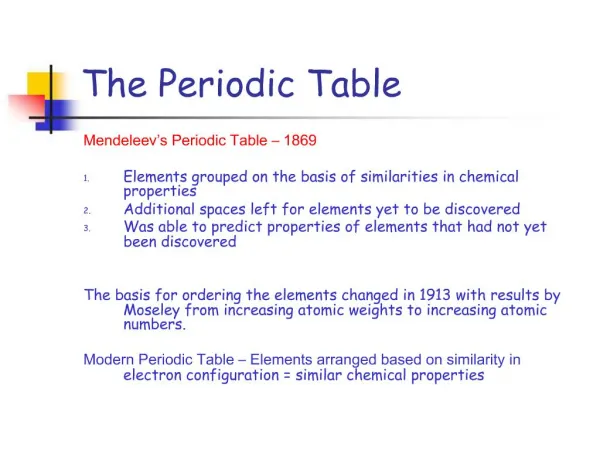
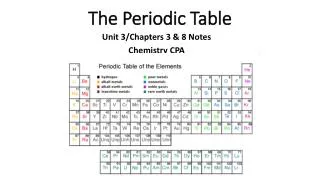
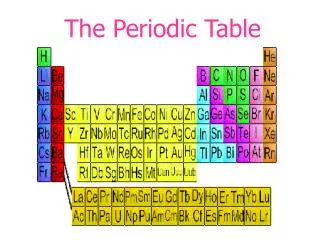
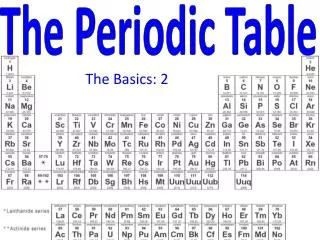
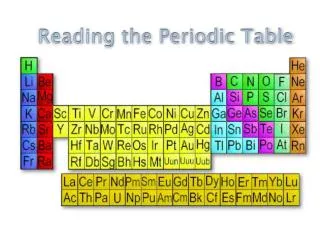
A way of organizing & classifying elements • Arranged in rows and columns • Created by Dimitri Mendeleev, a Russian Chemist in 1869 • First table arranged by atomic weight
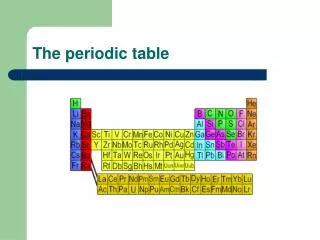
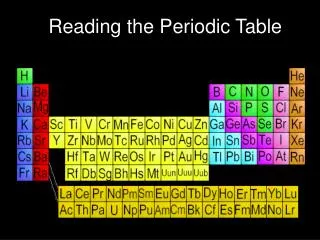
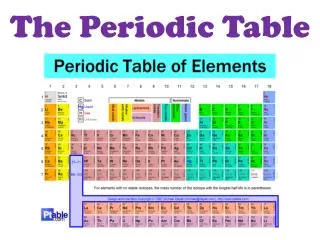
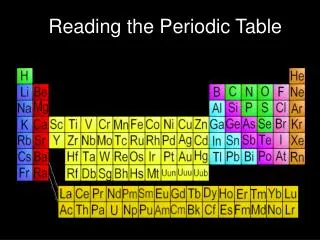
Columns • The vertical (up and down) columns of the periodic table (there are 18) are called groups or families. • Elements in the same group or family have similar characteristics or properties.
Rows • The horizontal rows of the periodic table are called periods. • Elements in a period are not alike in properties. • The first element in a period is usually an active solid, and the last element in a period is always an inactive gas.
Rows • Atomic size (number of protons) decreases from left to right across a period. • Atomic mass (number of protons) increases from left to right across a period.
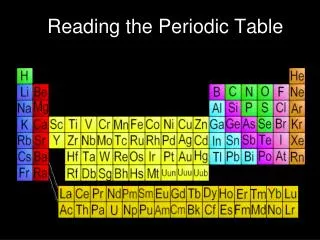
Rows • Metals are on the left • Non-metals are on the right
ALKALI METALS • very reactive metals that do not occur freely in nature • malleable, ductile, good conductors of heat and electricity. • softer than most other metals • can explode if they are exposed to water
ALKLINE EARTH METALS • metals • very reactive • not found free in nature
TRANSITION METALS • ductile and malleable, and conduct electricity and heat • iron, cobalt, and nickel, are the only elements known to produce a magnetic field.
RARE EARTH ELEMENTS • many are man-made
OTHER METALS • are ductile and malleable • are solid, have a relatively high density, and are opaque
METALLOIDS • have properties of both metals and non-metals • some of the metalloids, such as silicon and germanium, are semi-conductors. This means that they can carry an electrical charge under special conditions. This property makes metalloids useful in computers and calculators
NON-METALS • not able to conduct electricity or heat very well • very brittle, and cannot be rolled into wires or pounded into sheets • exist in two of the three states of matter at room temperature: gases (such as oxygen) and solids (such as carbon). • have no metallic luster, and do not reflect light.
HALOGENS • "halogen" means "salt-former" and compounds containing halogens are called "salts" • exist in all three states of matter: • Solid- Iodine, Astatine • Liquid- Bromine • Gas- Fluorine, Chlorine
NOBLE GASES • do not form compounds easily
Your Turn… With a partner complete the scavenger hunt given you by your teacher. The first team to turn in a hunt with ALL the correct answers will receive a reward.