Understanding Oxidation Numbers and Ionic Compounds
This resource provides a comprehensive overview of oxidation numbers in elements and how they combine to form ionic compounds. It highlights the typical charges of groups in the periodic table and explains the principles of bond formation among elements. Detailed examples, including binary ionic and covalent compounds, are presented for clarity. Students will learn how to determine oxidation states and effectively name various compounds through systematic steps. This guide serves as an essential tool for chemistry learners and educators alike.

Understanding Oxidation Numbers and Ionic Compounds
E N D
Presentation Transcript
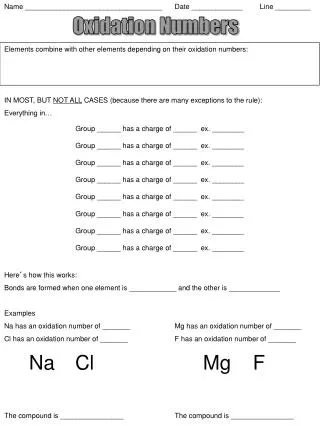
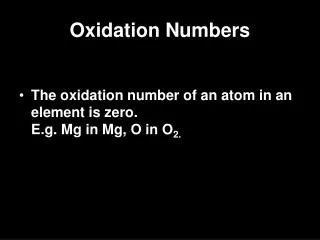
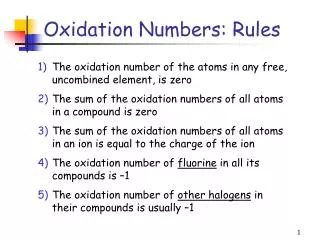
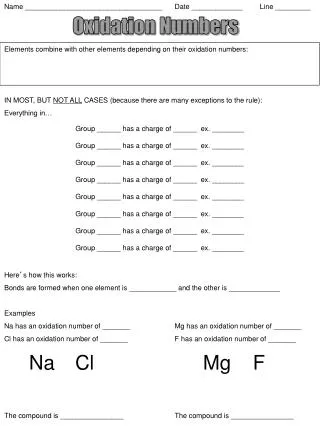
Name ___________________________________ Date _____________ Line _________ Mg F Oxidation Numbers Elements combine with other elements depending on their oxidation numbers: IN MOST, BUT NOT ALL CASES (because there are many exceptions to the rule): Everything in… Group ______ has a charge of ______ ex. ________ Group ______ has a charge of ______ ex. ________ Group ______ has a charge of ______ ex. ________ Group ______ has a charge of ______ ex. ________ Group ______ has a charge of ______ ex. ________ Group ______ has a charge of ______ ex. ________ Group ______ has a charge of ______ ex. ________ Group ______ has a charge of ______ ex. ________ Here’s how this works: Bonds are formed when one element is ____________ and the other is _____________ Examples Na has an oxidation number of _______ Mg has an oxidation number of _______ Cl has an oxidation number of _______ F has an oxidation number of _______ The compound is ________________ The compound is ________________ Na Cl
How to name a BINARY IONIC COMPOUND: • (________________________________________________________) • STEPS: • ____________________________________________________________________________ • ____________________________________________________________________________ • ____________________________________________________________________________ • EXAMPLE: • NaCl Mg2O Al2S3 • How to name a BINARY COVALENT COMPOUND: • (________________________________________________________) • STEPS: • ______________________________________________ • ______________________________________________ • N2O5 CO2 + ion and element - ion and element Compound Compound Name Li1+ F1- K2O Sodium Iodide
Name __________________________________ Date ___________ Oxidation Numbers Fill in the empty spots on the chart for the ionic compounds using what you already have to help. + ion and element - ion and element Compound Compound Name Mg1+ Cl1- BBr3 Potassium Sulfide Al3+ Cl1- Ca2+ N3- Lithium Selenide BeF2 Al3+ O2- BP Strontium Telluride Ba3N2 Na1+ O2- Magnesium Oxide Cs3N