Transforming Language Learning through Interactive Journals and Student Reflection
50 likes | 171 Vues
This study explores recent trends in language learning that focus on student comfort and introspection. It highlights the growing comfort in language classrooms (FLCAS) and the prevalence of visual learners. Emphasized strategies include the use of interactive reflective journals, which have significantly improved student attitudes and confidence. As students engage in self-assessment and reflect on their learning experiences, they've shown increased depth in their journal entries and a decrease in grammatical inaccuracies. The interactive approach fosters an environment of collective exploration and positive attitude shifts toward learning.


Transforming Language Learning through Interactive Journals and Student Reflection
E N D
Presentation Transcript
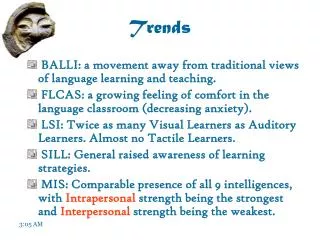
Trends • BALLI: a movement away from traditional views of language learning and teaching. • FLCAS: a growing feeling of comfort in the language classroom (decreasing anxiety). • LSI: Twice as many Visual Learners as Auditory Learners. Almost no Tactile Learners. • SILL: General raised awareness of learning strategies. • MIS: Comparable presence of all 9 intelligences, with Intrapersonal strength being the strongest and Interpersonal strength being the weakest.
Trends • CLE: heightened awareness of the significance of the learning environment. • CEQ: heightened awareness of the importance of matching preferred and actual learning environments. • Self-Assessment, Confidence: students responded positively. • Self-Assessment, Motivation: students responded positively.
Results • weekly entries in the journal increased in length over the course of the semester; • the number of grammatical inaccuracies decreased without teacher-correction; • the individual reflections gained in depth as students became more articulate; • topics of the individual reflections became more oriented to language learning (students wrote about whatever they felt to be important to them); • there was a noticeable shift in the entries from initial confusion (about the future) and lack of confidence, towards determination to "do my best"; and • individual reflections showed encouraging indications of positive attitude change.
Results • The interactive/reflective learner journal was a definite factor in attitude change for a number of reasons: • Being both interactive and reflective, the journal gave students a framework in which to discuss issues which had not previously been explored by them in any depth. • By allowing students to reflect individually upon whatever they found to be important, and by stressing that there were no "correct" answers, the journal encouraged growth of confidence and self-esteem in students who had previously labeled themselves as poor learners.
Results • By allowing groups to proceed through the journal at their own pace, students were allowed to spend time on issues that they found meaningful. • By bringing teaching/learning-related issues to the attention of the students, the journal promoted cooperative exploration of beliefs, leading to positive modification of attitudes to learning. • By encouraging students to make individual reflections on a regular basis, without correction by the teacher, the fear of "making mistakes" was disabled, and writing skills were allowed to improve simply through extended practice and occasional peer-feedback.