Polyatomic Ions
Polyatomic ions play a vital role in chemistry as they consist of two or more different non-metal atoms bonded by covalent bonds. The ammonium ion (NH4+) is the only common polyatomic cation, while various polyatomic anions typically end in "-ate". Writing formulas for these ions requires special attention to parentheses when more than one polyatomic ion is present. This guide also highlights common polyatomic ions and provides insights into proper formula notation in ionic compounds.

Polyatomic Ions
E N D
Presentation Transcript
Polyatomic Ions What is a cation afraid of? Answer: A dogion…
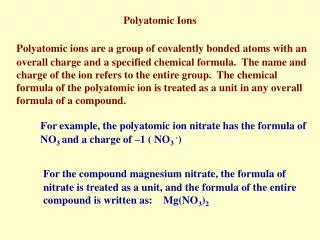
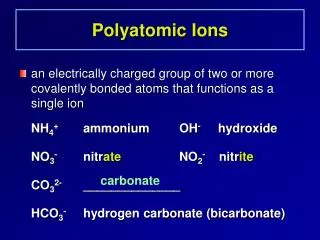
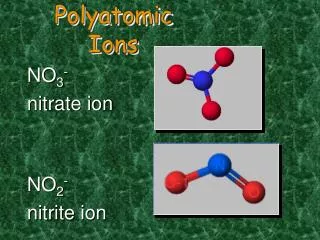
Many ionic compounds are not binary because one or both ions contain atoms of more than one element. These polyatomic ions consist of two or more different non-metal atoms, which are joined by covalent bonds. There is only one common polyatomic cation: the ammonium ion, NH4+. There are many polyatomic anions. Except for the hydroxide ion, the names of the
anions end in “-ate” instead of “ide”. Writing formulas is also the same, except that you have to add parentheses when the formula requires more than one polyatomic ion. Common polyatomic ions.