

SlideServe
Menu
Préférences
© SlideServe · v2026

Polyatomic Ions

morrison avatar
4 diapositives · 380 Views · Aug 06, 2014

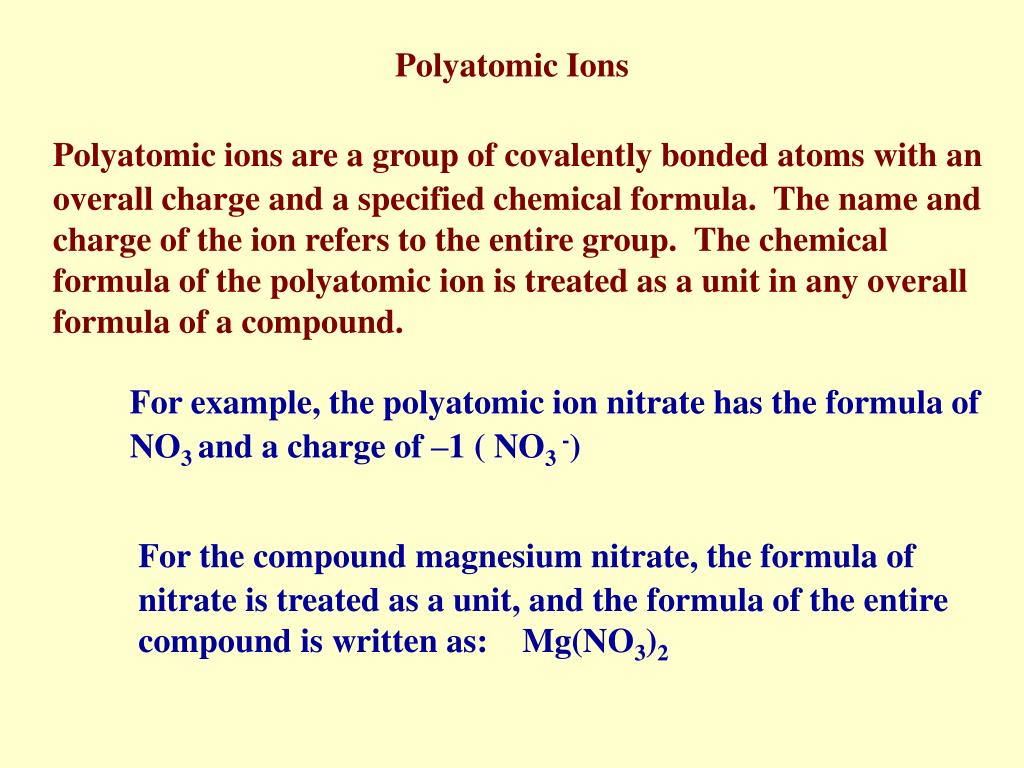
Polyatomic Ions. Polyatomic ions are a group of covalently bonded atoms with an overall charge and a specified chemical formula. The name and charge of the ion refers to the entire group. The chemical formula of the polyatomic ion is treated as a unit in any overall
Polyatomic Ions - slide 1
01 / 4Polyatomic Ions
1 / 17

Télécharger la présentation

Polyatomic Ions
Une image / un lien ci-dessous est fourni (tel quel) pour télécharger la présentation

Politique de téléchargement : le contenu du site vous est fourni TEL QUEL pour votre information et votre usage personnel ; il ne peut être vendu, concédé sous licence ni partagé sur d’autres sites sans l’accord de son auteur.Le contenu vous est fourni TEL QUEL, pour votre information et votre usage personnel uniquement. Téléchargez la présentation en cliquant sur ce lien. Lors du téléchargement, si vous ne parvenez pas à télécharger une présentation, l’éditeur a peut-être supprimé le fichier de son serveur.Pendant le téléchargement, si vous ne parvenez pas à obtenir une présentation, le fichier a peut-être été supprimé par l’éditeur.

F I N

Plus de contenu associé

Transcription de la présentation
  1. Polyatomic Ions Polyatomic ions are a group of covalently bonded atoms with an overall charge and a specified chemical formula. The name and charge of the ion refers to the entire group. The chemical formula of the polyatomic ion is treated as a unit in any overall formula of a compound. For example, the polyatomic ion nitrate has the formula of NO3 and a charge of –1 ( NO3 -) For the compound magnesium nitrate, the formula of nitrate is treated as a unit, and the formula of the entire compound is written as: Mg(NO3)2

  2. The formulas and charges of polyatomic ions are not easily predicted so you will be responsible for memorizing the names, formula, and charge of the following polyatomic ions. Anions OH – CO32 PO43 – NO3SO4 2 ClO3CrO4 2 – C2H3O2Cr2O7 2 – HCO3  MnO4 O2 2 CN  Cations NH4 +

  3. Polyatomic ions are named as a unit. Polyatomic anions that include oxygen use the “ate”, ending except for hydroxide. Polyatomic anions without oxygen use the “ide” ending.

  4. Anions Cations OH – hydroxide NH4 + ammonium NO3nitrate ClO3chlorate C2H3O2 acetate HCO3 hydrogen carbonate MnO4 permanganate O2 2 peroxide CN  cyanide CO32 carbonate SO4 2 sulfate CrO4 2 – chromate Cr2O7 2 – dichromate PO43 – phosphate