Fascinating Facts About the Human Skeletal System
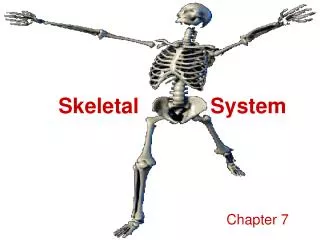
Discover the intriguing aspects of the human skeletal system, including the fact that infants are born with 270 bones, which later fuse to 206 bones in adulthood. Explore the two divisions of bones: the axial skeleton, which supports the skull and spine, and the appendicular skeleton, which includes limbs and girdles. Learn about the functions of bones—support, protection, movement, storage, and blood cell formation—along with the various types, such as compact and spongy bone. Delve into the structure and significance of the spinal column and pelvis and how sex differences affect skeletal anatomy.

Fascinating Facts About the Human Skeletal System
E N D
Presentation Transcript
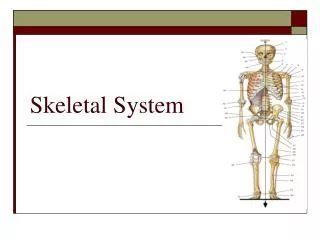
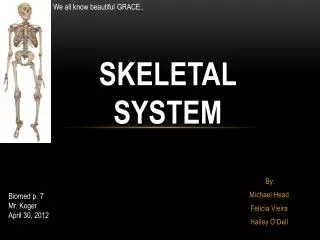
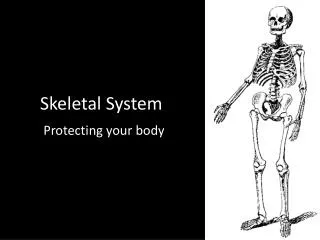
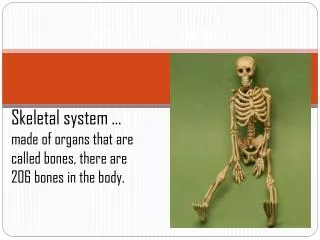
Fun Facts • 270 bones in an infant but several fuse together • 206 bones in human body • largest is femur, smallest ossicles http://www.youtube.com/watch?v=flIAxGsV1q0
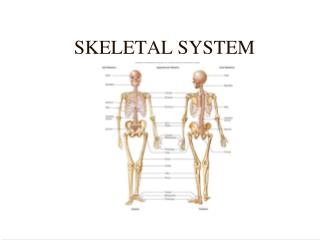
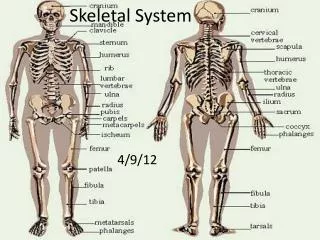
2 Divisions • axial– makes longitudinal axis of body skull, spine, rib cage, sternum 2. appendicular-bones of limbs and girdles • also includes joints, ligaments (bone-bone connectors), cartilages
Function • Support - maintains structure of body - helps hold some organs in place • Protection - protects soft body organs (brain, heart, etc.) • Movement - tendons attach muscles to bones • Storage - fat stored in cavities of bones - bones store minerals (Calcium & Phosphorus) • Formation of Blood Cells AKA hematopoiesis
Types of Bone • Compact Bone- dense, looks smooth • Spongy Bone- has small needle-like pieces of bone and lots of open space
Spinal Column • spinal cord passes through center of vertebrae • Via vertebral foramen • made of 26 irregular bones connected by ligaments to allow flexibility of spine • When born there are 33 *think meal times to remember #’s 7am, 12 pm, 5 pm… we’ll get back to this http://www.youtube.com/watch?v=QWCKiyKuL8c start @ 46 sec
Spinal Column • Are pads between vertebrae intervertebral discs • As you age discs harden • drying of discs and weakening of the ligaments predisposes people to herniated discs
Spinal Column • Curvature in thoracic and sacral regions are present at birth (primary curvatures) • Curvature in cervical & lumbar regions develop after birth (secondary curvatures) • cervical curvature allows baby to raise its head • lumbar curvature allows walking
Cervical Vertebrae • 7 cervical vertebrae • 1st called Atlas • No body, superior surface has depressions for the occipital condyles (bumps on the base of the skull) can shake head yes • 2nd called Axis • Has a large process called (dens) on the superior surface can shake head no
How to Know a Cervical Vertebrae When You See One… • C3-C7 • smallest, lightest vertebrae • short spinous process • foramina (holes) in transverse processes (through which arteries flow)
How to Know a Thoracic Vertebrae When You See One… • T1-T12 • larger than cervical • only vertebrae that articulate (fit) with ribs • heart-shaped body • 2 facets- 1 set for ribs and 2 set for neighboring vertebrae • long spinous process that hooks down
How to Know a Lumbar Vertebrae When You See One… • L1-L5 • large, block-shaped bodies • spinous process like a hatchet • sturdiest vertebrae
Remember these… They’re back!
Rib Cage • Sternum • flat bone • formed by the fusion of 3 bones • manubrium (superior) • body (middle) • xiphoid process (inferior) • attached to first 7 ribs • bone marrow can be take from here since it’s superficial
Rib Cage • Ribs • 12 pairs, make walls of chest cavity • articulate w/ vertebrae and curve downward and toward the anterior body • 1st 7 pairs TRUE ribs - attach to sternum by cartilage • pairs 8-12 FALSE ribs – attach to sternum indirectly ( 3 pairs fuse with cartilage of other pair) OR lack sternal attachments • if no attachment to sternum FLOATING rib
Some LadiesTry Positions That They Can't Handle To remember the carpal bones :Scaphoid, Lunate, Triquetral, Pisiform, Trapezium, Trapezoid, Capitate, Hamate
Bone Shapes • Long bones- longer than they are wide, have a long shaft and heads at both ends • all limb bones are long bones EXCEPT the patella, wrist bones, & ankle bones • Short bones- cube-shaped • patella, wrist bones, & ankle bones • Flat bones- thin, flattened usually curved; 2 thin layers of compact bone & spongy bone between • most bones of skull, ribs, sternum • Irregular bones- bones that don’t fit into the other 3 categories • hip bones, vertebrae
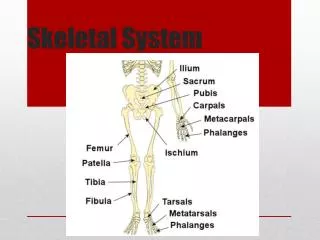
Pelvis • Purposes: • bearing weight • protects bladder, reproductive organs, & some of the large intestines • Hip bone made of • ilium- forms most of hips, has wings that flare out, connects w/ the sacrum, • iliac crest where you put hands on hips • ischium- “sit down bone” takes weight when you sit • pubis- most anterior part of pelvis -> forward buldge • meets w/ ischium to make obturator foramen for muscles, nerves, and bl vessels to go to the anterior part of thigh • all meet at the acetabulum where femur inserts
Males vs. Female Differences • female pelvis is shallower & bones are lighter • iliac crest of a female flare more laterally making opening larger and more circular • in females the pubic arch at bottom of pelvis is more rounded and larger than 90o • female acetabulum is more shallow more flexible
New Tricks… • Clavicle- put rounded side towards palm, large curve out from body & flat end in opposite hand, using opposite hand feel for the bump facing towards you, if not there other side • Tibia- Tough guy… big guy, larger side facing up, large bump to the front, longest process towards the inside/medial side of the ankle makes medial malleolus (can follow curve on shin) • Fibula- PUNY, feel the 2 necks, skinny neck on top, larger/flatter neck on bottom, largest inferior process must be POSTERIOR and on the lateral side of the ankle makes lateral malleolus • Femur- ball and neck medially, large fossa to the back/towards your body, the direction the ball faces is the side • Patella- point down, hold like a controller with thumbs on smooth facets, broader side is the side that the patella is on • Pelvis- put knuckle of index finger in the sciatic notch, if you can wrap four fingers around and into the hip bone fossa ACETABULUM that’s the side