Understanding the Cell Cycle: Phases, Process, and Importance
The cell cycle is a crucial process of growth, development, and division in cells, composed of Interphase, Mitosis, and Cytokinesis. Interphase consists of three stages: G1 (cell growth and organelle production), S (DNA replication), and G2 (preparation for division). Mitosis follows Interphase, comprising four stages: Prophase (DNA condenses), Metaphase (chromosomes align), Anaphase (chromosomes separate), and Telophase (nuclear membrane reforms). Finally, Cytokinesis divides the cytoplasm, resulting in two daughter cells, with distinct processes for animal and plant cells.


Understanding the Cell Cycle: Phases, Process, and Importance
E N D
Presentation Transcript
The Cell Cycle… The cell cycle is a cycle of growth, development, and division. It is made up of different phases: 1. Interphase 2. Mitosis 3. Cytokinesis
Interphase • Interphase - cell grows and develops • Cells spend the longest period of time in interphase • It has 3 parts: • 1. G1 – Growth to full size, production of organelles • 2. S - DNA is replicated (copied) • 3. G2 – Cell prepares for division
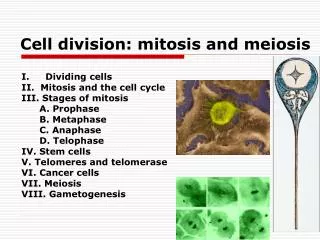
Mitosis – the nucleus and it’s contents divide • Follows interphase • Has 4 parts: • Prophase • Metaphase • Anaphase • Telophase
1. Prophase • Copied DNA condenses in chromosomes • Nucleus disappears • Spindle fibers form • 2. Metaphase • Chromosomes line up in the middle of the cell • Spindle fibers attach to them
3. Anaphase • Chromosomes separate due to spindle fibers pulling the apart • 4. Telophase • Nuclear membrane forms • Chromosomes unwind • Spindle fibers break down
Cytokinesis – the division of the cytoplasm and it’s contents • Animal cell – cell membrane pinches together to divide the cell into two new daughter cells • Plant Cell – a cell plate forms and divides the cell into two new daughter cells