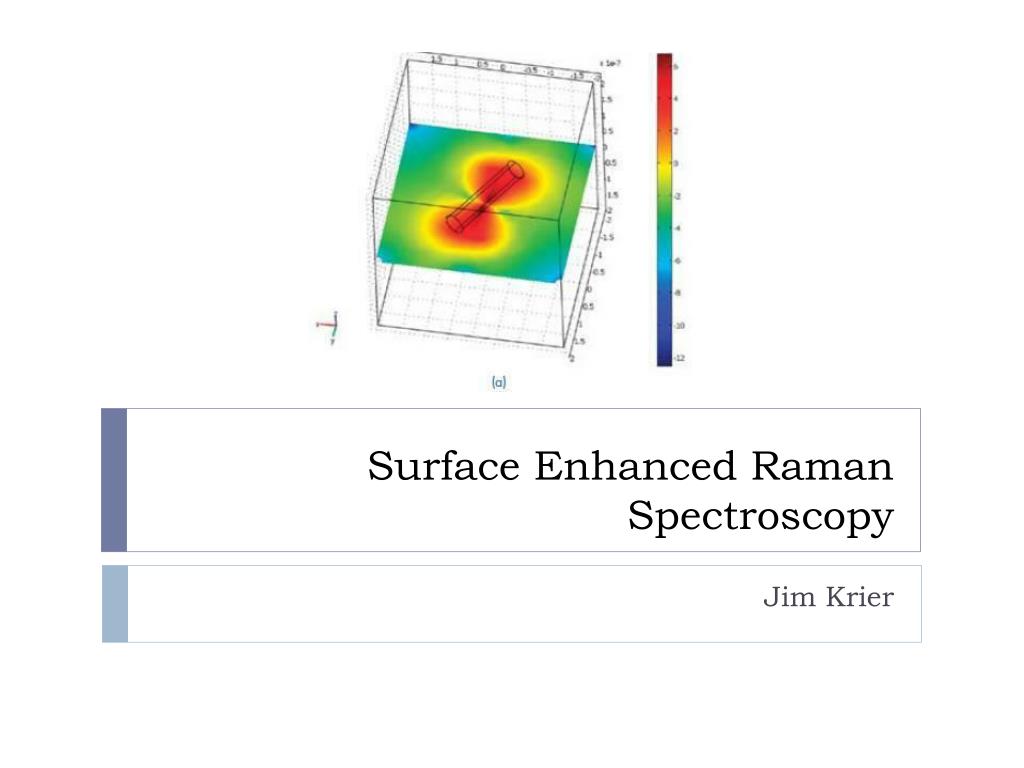
Surface Enhanced Raman Spectroscopy Jim Krier
Raman scattering Scattering is typically 10-6 lower in intensity than Rayleigh intensity (signal enhancement needed!) Difficult to differentiate among small molecules with similar covalent bonds Raman used as a complement to IR spectroscopy commons.wikimedia.org; “Physical Chemistry” by Mortimer, 2000.
SERS enhancement First reported by Martin Fleishman in 1974 Electric field enhancement from plasmon excitation Directionality of adsorbates/phonons is a critical element of enhancement factor (EF) In effect, plasmons convert the Rayleigh signal to a Stokes shift Prokes, S.M.; Glembocki, O.J.; Rendell, R.W. NRL Review 2007, 175.
Orientation issues Visible laser Pyridine Fleischmann, M.; Hendra, P. J.; McQuillan, A. J., Chem. Phys. Lett .1974, 26,163.
Rhodamine 6G Hildebrandt, P.; Stockburger, M. J. Phys. Chem. 1984, 88, 5935.
Tao, T.; Kim, F.; Hess, C.; Goldberger, J.; He, R.; Yugang, S.; Younan, X.; Yang, P. Nano Lett. 2003, 3, 1229.
Langmuir-Blodgett trough Tao, T.; Kim, F.; Hess, C.; Goldberger, J.; He, R.; Yugang, S.; Younan, X.; Yang, P. Nano Lett. 2003, 3, 1229.
“Logs-on-a-river” Tao, T.; Kim, F.; Hess, C.; Goldberger, J.; He, R.; Yugang, S.; Younan, X.; Yang, P. Nano Lett. 2003, 3, 1229.
R6G detection EF ~ 2 x 10⁹ Tao, T.; Kim, F.; Hess, C.; Goldberger, J.; He, R.; Yugang, S.; Younan, X.; Yang, P. Nano Lett. 2003, 3, 1229.
2,4-Dinitrotoluene detection NO2 stretching mode EF ~ 2 x 10⁵ ~ 0.7 picogram sensitivity Tao, T.; Kim, F.; Hess, C.; Goldberger, J.; He, R.; Yugang, S.; Younan, X.; Yang, P. Nano Lett. 2003, 3, 1229.
Advantages of nanowire monolayers Well defined, reproducible media that can be put atop a variety of solid materials Geometric structure allows larger electric field enhancement compared to nanospheres Can be used to detect analytes which are air-bourne or in solution Prokes, S.M.; Glembocki, O.J.; Rendell, R.W. NRL Review 2007, 175.
Cao, Y.C.; Jin, R.; Mirkin, C.A. Science2002, 297, 1536.
Dye tagging Cao, Y.C.; Jin, R.; Mirkin, C.A. Science2002, 297, 1536.
Cao, Y.C.; Jin, R.; Mirkin, C.A. Science2002, 297, 1536.
Further reading … Tao, T.; Kim, F.; Hess, C.; Goldberger, J.; He, R.; Yugang, S.; Younan, X.; Yang, P. Nano Lett. 2003, 3, 1229. Cao, Y.C.; Jin, R.; Mirkin, C.A. Science2002, 297, 1536. SERS review article: Kneipp, K.; Kneipp, H.; Itzkan, I.; Dasari, R. R.; Feld, M. S. J. Phys.: Condens. Matter 2002, 14, R597.