Genes and Chromosomes in Genetics
690 likes | 714 Vues
Explore the significance of genes, alleles, mutations, and chromosomes in genetics. Learn how DNA codes for proteins that control traits, the impact of mutations, and genetic disorders.


Genes and Chromosomes in Genetics
E N D
Presentation Transcript
What is a Gene? • Gene = a segment of DNA that codes for a protein that controls a trait. • Humans have approximately 30,000 genes • We have 2 copies of each gene (one on each chromosome we inherited from our parents). • Each gene has different forms . . . • Allele –one of the many forms of a gene.
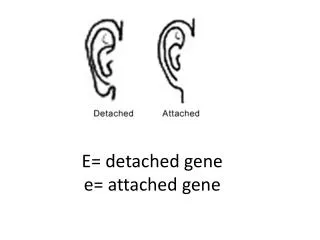
Examples of Genes and Alleles in Pea Plants • Gene – Seed Shape Alleles: _____________ _____________ • Gene – seed color Alleles: _____________ _____________ • Gene – flower color Alleles: _____________ _____________
Chromosomes occur in pairs because offspring inherit one from each parent • *We have 46 Chromosomes (23 pairs of chromosomes) • Chromosomes are made of genes • Circle one gene. • What are the 2 alleles for that gene? *Each chromosome is made up of DNA that contains hundreds to thousands of GENES. *HIERARCHY: CHROMOSOMES CONTAIN DNA MADE OF GENES CODE FOR A PROTEIN MAKE TRAITS
Dominant vs. Recessive • NOT ALL ALLELES ARE EXPRESSED! Some alleles are dominant, while others are recessive
MUTATIONS Changes in DNA that affect genetic information
Gene Mutations • Point Mutations – changes in one or a few nucleotides • Substitution • THE FAT CAT ATE THE RAT • THE FAT HAT ATE THE RAT • Insertion • THE FAT CAT ATE THE RAT • THE FAT CAT XLW ATE THE RAT • Deletion • THE FAT CAT ATE THE RAT • THE FAT ATE THE RAT
Gene Mutations • Frameshift Mutations – shifts the reading frame of the genetic message so that the protein may not be able to perform its function. • Insertion • THE FAT CAT ATE THE RAT • THE FAT HCA TAT ETH ERA T • Deletion • THE FAT CAT ATE THE RAT • TEF ATC ATA TET GER AT H H
Chromosome Mutations • Changes in number and structure of entire chromosomes • What do scientists use to identify these type of mutations? • Original Chromosome ABC * DEF • Deletion AC * DEF • Duplication ABBC * DEF • Inversion AED * CBF • Translocation ABC * JKL GHI * DEF
Your cells have autosomes and sex chromosomes. • Your body cells have 23 pairs of chromosomes. • Homologous pairs of chromosomes have the same structure. • For each homologous pair, one chromosome comes from each parent. • Chromosome pairs 1-22 are autosomes. • Sex chromosomes, X and Y, determine gender in mammals.
Molecular Techniques • By investigating body tissue, scientists can detect problems. • Genetic problems can be identified by defective proteins/enzymes or a negative affect on the bodies metabolism. • Genes can be studied directly
How do they get the chromosomes? Chorionic villus sampling Amniocentesis
Karyotypes a set of photographs of chromosomes grouped in order in pairs from one cell. What are some observations we could make from this karyotype?
Male vs. Female • Males have XY sex chromosomes. • Females have XX sex chromosomes • The Y chromosome carries very few genes essential for life. • The X chromosome is a much longer DNA molecule and contains many, many genes that are needed for cells to function.
Karyotype Notation • A short-hand way to write a person’s karyotype. • Total # of chromosomes, sex chromosomes, extra or missing chromosomes • Normal Female • 46XX • Normal Male • 46XY
Significance of Mutations 1. Most are neutral • Eye color • Birth marks 2. Some are harmful • Sickle Cell Anemia • Down Syndrome 3. Some are beneficial • Sickle Cell Anemia to Malaria • Immunity to HIV
What Causes Mutations? • There are two ways in which DNA can become mutated: 1. Mutations can be inherited. • Parent to child 2. Mutations can be acquired. • Environmental damage • Mistakes when DNA is copied • Non-disjunction-failure of chromosomes to separate properly during Meiosis.
What are we making during Meiosis? In your own words what is a non-disjunction?
Genetic Disorders • an illness caused by one or more abnormalities in the genome, especially a condition that is present from birth. • Conditions may or may not be inherited. • Mutations occur all the time in every cell in the body. • Each cell, however, has the remarkable ability to recognize mistakes and fix them before it passes them along to its descendants. • But a cell's DNA repair mechanisms can fail, or be overwhelmed, or become less efficient with age.
Turners Syndrome Caused by a nondisjunction, if a pair of sex chromosomes fails to separate during the formation of an egg or sperm • Affects1 in 2,500 newborns • 45 chromosomes; have only 1 X chromosome • #23 Monosomy • girls fail to go thru puberty
Turners Syndrome • 96-98% do not survive to birth • stocky appearance • short webbed neck • Other medical symptoms include: • lymphedema (swelling of hands and feet) • heart and/or kidney defects • high blood pressure • infertility (inability to have children)
Cri-Du-Chat Syndrome • These children have a deleted portion of chromosome number 5. • Estimated 1 in 20,000-50,000 newborns • Found in ALL ethnic backgrounds • Not inherited • Can be XY or XX • #5 Deletion
Cri-Du-Chat Syndrome • Cry that is high-pitched and sounds like a cat • Downward slant to the eyes • Low birth weight and slow growth • Low-set or abnormally shaped ears • Mental handicap (intellectual disability) • Partial webbing or fusing of fingers or toes • Slow or incomplete development of motor skills • Small head (microcephaly) • Small jaw (micrognathia) • Wide-set eyes
WAGR Syndrome • The condition results from a deletion on chromosome 11 resulting in the loss of several genes 1 in 500,000 children under age 15 7 in 1000 cases have Wilms Tumor 46 chromosomesXY or XX #11 Deletion of upper arm
Aniridia-Wilms Tumor Syndrome • Predisposed to Wilms kidney tumor • Mentally handicapped • Severe childhood obesity • Growth retardation • Blindness • Tumors on kidneys • Short lifespan • Missing the iris of the eye
Thirteen Q Deletion Syndrome 600 cases worldwide 1st diagnosed 20 years ago 46 chromosomes Affects XY or XX #13 Deletion of lower arm
Thirteen Q Deletion Syndrome Mentally retarded Deformed face No thumbs Heart disease Short lifespan
Prader-Willi Syndrome Prader-Willi syndrome is caused by a gene missing on part of chromosome 15. Normally, your parents each pass down a copy of this chromosome. Most patients with Prader-Willi syndrome are missing the genetic material on part of the father's chromosome. 1 in 15,000 live births46 chromosomes XY=97% XX=3% #15 Deletion of lower arm
Prader-Willi Syndrome Low muscle tone Short stature Incomplete sexual development Cognitive disabilities Problem behaviors Chronic feeling of hunger Obesity Shorter lifespan
Eighteen Q Deletion Syndrome 1 in 40,000 newborns Estimated 100 babies per year 46 chromosomesXY or XX #18 Deletion of lower arm
Eighteen Q Deletion Syndrome Symptoms correlate with the size of the deletion Mentally handicapped Heart disease Abnormal hands and feet Large eyes Large ears Normal lifespan
Cat-Eye Syndrome 1 in 1,000,000 births 46 chromosomes Affects XY or XX #22 Deletion of bottom arm
Cat-Eye Syndrome • Normal to severe malformations • Fused fingers and toes • Mentally handicapped • Small jaw • Heart problems • Normal lifespan
Four-Ring Syndrome 1 in 10,000,000 births 46 chromosomesXY or XX #4 Inversion
Four-Ring Syndrome Cleft palate Club feet Testes don’t descend Short lifespan
Trisomy 21 Down Syndrome Down Syndrome 1 in 31,000 births46 chromosomes XY=97% XX=3% #14/21 Translocation 1 in 850 newborns Estimated 250,000 people are affected in the US 47 chromosomesXY or XX #21 Trisomy Nondisjunction
Down Syndrome • Short, broad hands • Stubby fingers • Rough skin • Impotency in males • Mentally handicapped • Cognitive delays • Small round face • Protruding tongue • Short lifespan • Increased risk of developing Alzheimer disease
Patau’sTrisomy Syndrome 1 in 14,000 births 47 chromosomesXY or XX #13 Trisomy Nondisjunction
Patau’s Trisomy Syndrome Small head Small or missing eyes Heart defects Extra fingers Mentally handicapped Cleft palate Most die a few weeks after birth
Edward’s Trisomy Syndrome 1 in 4,400 births47 chromosomes XX=80% XY=20% #18 Trisomy Nondisjunction
Edward’s Trisomy Syndrome Small head Mentally handicapped Internal organ abnormalities 90% die before 5 months of age
Jacob’s Syndrome 1 in 1,800 births 47 chromosomesXYY only #23 Trisomy Nondisjunction
Jacob’s Syndrome ? Normal physicallyNormal mentally Increase in testosterone More aggressive Normal lifespan
Klinefelter Syndrome 1 in 1,100 births 47 chromosomesXXY only #23 Trisomy Nondisjunction
Klinefelter Syndrome Scarce beard Longer fingers and arms Sterile Delicate skin Low mental ability Normal lifespan
Triple X Syndrome 1 in 2,500 births 47 chromosomesXXX only #23 TrisomyNondisjunction