Understanding Cell Structures: Prokaryotic vs. Eukaryotic Cells and Their Organelles
Cells are the fundamental units of life, composed of prokaryotic and eukaryotic types, each with unique structures and functions. Prokaryotic cells lack a nucleus and organelles, while eukaryotic cells contain a nucleus and various organelles. Key organelles include the endoplasmic reticulum, Golgi apparatus, lysosomes, and mitochondria, each playing vital roles in cellular processes. Understanding these differences and the functionalities of organelles enhances our knowledge of life at the cellular level and the evolution of complex organisms.

Understanding Cell Structures: Prokaryotic vs. Eukaryotic Cells and Their Organelles
E N D
Presentation Transcript
CELL STRUCTURECH 6 Cells are the smallest collection of matter that is alive All living things are made of cells All cells descend from pre-existing cells All cells share several basic features
I. Why are cells so small?A. The surface – to – volume theory
Metabolic requirements limit cell size • Surface area to volume ratio of a cell is critical to its metabolic efficiency • Surface area increases by n2 while volume increases by n3 • Smaller cells have a larger surface area to volume ratio
B. How cells can increase in size without decreasing the SA/V ratio:
increase their surface area or decrease their volume • Organelles • Plant cells : large central vacuole • Nerve cells: long skinny extensions • Intestinal cells: highly folded cell membrane
II. Prokaryotic cells vs Eukaryotic cellsA. Prokaryotic cells • No nucleus or organelles • Circular DNA in a nucleoid region • Cytoplasm and ribosomes surrounded by cell membrane
B. Eukaryotic cells • Have linear chromosomes in nucleus • Organelles • Bigger than prokaryotic cells
C. All cells have: • Cell membrane to let things in and out • Ribosomes for protein synthesis • Cytoplasm where many enzymatic reactions occur • Chromosomes that contain genes
D. Cell wall: protection and support • in prokaryotic and some eukaryotic cells • cellulose in plants • chitin in fungi • peptidoglycan in bacteria (not archaea)
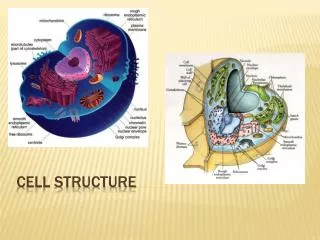
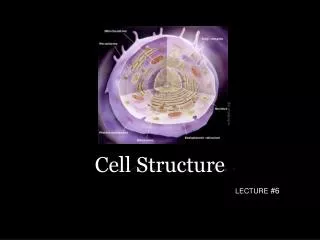
III. A Tour of Eukaryotic Cells • Eukaryotic cells have internal membranes forming organelles • This localizes cellular activities to different parts of cell • All eukaryotic cells have nearly the same organelles
A. The endomembrane system is composed of the nucleus, ER, Golgi, lysosomes, vacuoles, and cell membrane • 1. Evolution • most widely accepted model is thru invagination of the cell membrane
2. nucleus What are some structural features of nucleus?
contains most of the cell’s DNA • surrounded by nuclear envelope that is double membrane with pores • contains chromosomes and nucleolus (synthesize ribosomal RNA) • pores regulate what enters and leaves • What enters and leaves?
RNA that leaves nucleus is used by ribosome to make protein • Free ribosomes are in cytoplasm and make proteins that stay in cytoplasm • Bound ribosomes are on RER and make membrane bound proteins or proteins that leave the cell
3. endoplasmic reticulum (ER): the cell’s factory • highly folded membranecontinuous with nuclear membrane
types • rough ER (RER) • membrane is studded with ribosomes • it helps synthesize and modify proteins that will be transported • smooth ER (SER) • no ribosomes on it • it synthesizes carbs and lipids • it detoxifies drugs
Questions: • a. what type of cell would have a lot of RER? Why? • b. what type of cell would have a lot of SER? Why?
4. Golgi apparatus: shipping and receiving • Flatted stack of membranes found near the RER • It receives proteins from the RER and packages them for transport out of the cell
membrane bound organelles with digestive enzymes in acidic environment • digest macromolecules (phagocytosis) • digest and recycle old organelles (autophagy) • digest bacteria and viruses • digest cells destined to be destroyed (apoptosis)
6. Vacuoles: storage depots • Derived from ER and Golgi • Central vacuole in plants stores water and gives plant cell its rigid shape
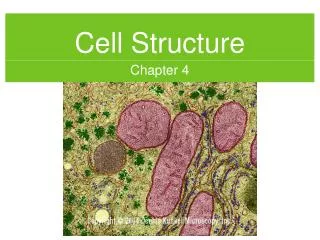
B. Mitochondria and Chloroplasts: convert energy from one form to another 1. mitochondria • double membraned organelle where the inner membrane is folded into cristae • site of ATP synthesis via aerobic respiration • purpose of cristae?
2. chloroplast • double membraned organelle which contains stacks of membrane sacs (thylakoids) called grana • contain chlorophyll • use the energy from the sun to make a precursor to glucose by photosynthesis • purpose of thylakoids?
3. Evolutionary Origins of Mitochondria and Chloroplasts: Endosymbionttheory • Have similarities with bacteria • Have ribosomes and DNA similar in size and structure to bacteria • Same size • Divide independently from rest of cell http://www.sumanasinc.com/webcontent/animations/content/organelles.html