Download
1 / 17
170 likes | 281 Vues
Explore the transformative journey of rights in the US Constitution through amendments spanning civil liberties, suffrage, and governance practices.

E N D
Bill of Rights • First 10 amendments • Rapps • Bare arms • Quartering troops • Search and seizure • Self incrimination, eminent domain • Legal proceedings • Jury in civil cases • Cruel and unusual punishment • Unenumerated rights • States rights
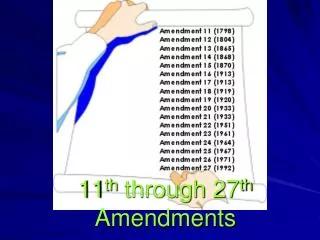
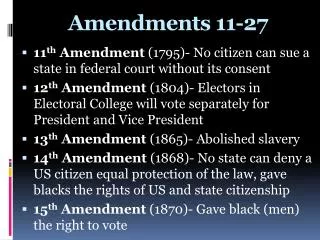
11th amendment • Ratified in 1798 • Places limits on an individual to sue the states
12th Amendment • Ratified in 1804 • Requires electors to the electoral college to cast a separate ballot for president and vice president
13th, 14th, 15th Amendments • Known as the Civil War/ Reconstruction Amendments • 13th was ratified in 1865 • No “involuntary servitude (abolished slavery) • 14th was ratified in 1868 • Defines citizens as “native Born Persons.” Extends the bill of rights and “EQUAL PROTECTION” to all citizens • 15th was ratified in 1870 • African American males granted the right to vote
16th Amendment • Ratified in 1913 • Grants the federal government the right to tax Income • Remember that income tax is the #1 source of revenue for the federal government.
17th Amendment • Ratified in 1913 • Direct election of senators by the people • Before the 17th amendment, state legislatures
18th Amendment • Ratified in 1919 • Also known as “Prohibition” • Made illegal the manufacture, sale and transport of alcohol
19th Amendment • Ratified in 1920 • Women’s Suffrage • Suffrage=right to vote
20th Amendment • Ratified in 1933 • Sets when congressional terms begin and end • Also says that if the president elect dies before he takes office, the vice president would take office
21st Amendment • Ratified in 1933 • Ended Prohibition • What was prohibition? What Amendment was it? • What is the only way to “get rid of” an amendment?
22nd Amendment • Ratified in 1951 • Sets presidential term limits. A president can serve two four-year terms or a max of 10 years total. • If the vice president takes office, he/she can total ten years as president.
23rd Amendment • Ratified in 1961 • District of Columbia gets three electoral votes
24th Amendment • Ratified in 1964 • Outlawed the poll tax and other voting restrictions • Poll tax- Tax paid at the voting booth • Literacy tests- A nearly impossible test • Grandfather Clause- If your grandfather could vote, you can • Each of these were used to limit the voting rights of African Americans
25th Amendment • Ratified in 1967 • Presidential succession • President • Vice president • Speaker of the house • President Pro-tempore of the senate
26th Amendment • Ratified in 1971 • Sets the minimum voting age at no more that 18 • (can be less that 18, but not more)
27th Amendment • Ratified in 1992 • Established that congress cannot grant itself any pay raises unless it comes after the next congressional election.