Exploring the Meatpacking Industry and Its Cultural Impact
Join us for an insightful session on the meatpacking industry, which encompasses the slaughtering, processing, packaging, and distribution of livestock such as cattle, pigs, and sheep. Discover the historical evolution driven by railroads and refrigeration, and learn about Upton Sinclair's groundbreaking novel, "The Jungle," which exposed the deplorable working conditions and practices in early 20th-century meatpacking plants. We'll also delve into the role of immigrants in the industry and encourage you to keep a food journal this week to reflect on your dietary habits.

Exploring the Meatpacking Industry and Its Cultural Impact
E N D
Presentation Transcript
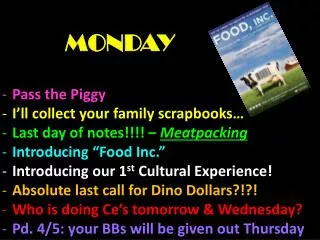
MONDAY • Pass the Piggy • I’ll collect your family scrapbooks… • Last day of notes!!!! – Meatpacking • Introducing “Food Inc.” • Introducing our 1st Cultural Experience! • Absolute last call for Dino Dollars?!?! • Who is doing Ce’s tomorrow & Wednesday? • Pd. 4/5: your BBs will be given out Thursday
An Introduction to the Meatpacking Industry Meatpacking Industry: handles the slaughtering, processing, packaging, & distribution of animals such as cattle, pigs, sheep and other livestock.
Where did it come from? The meat packing industry grew with… 1. railroads & refrigeration 2. Railroads made possible the transport of stock to central points for processing
“The Jungle” • Upton Sinclair novel • 1906 • Shocked public with the truths of poor working conditions & unsanitary practices in meat packing plants in the U.S. • Specifically targets Chicago.
Problems with the meatpacking industry • Overworked their employees • Failed to hold safety measures • Employers HATED unionization
Immigrants & Meatpacking • Immigrants used as strikebreakers • Employers pay migrant workers MUCH less
… Food for Thought … Keep a “food journal” for this week (until Thursday)…to make: fold a piece of paper into 2 so you have a top, and a bottom. FRONT: Write what you eat, on average, per day BACK: Write what you eat, on average, per week **BE GENERAL & PICK A DAY WHERE YOU EAT MORE THAN LESS*