Download
1 / 27
270 likes | 388 Vues
This chapter provides an overview of fire science education and the firefighter selection process. It explores the curriculum designed to provide a comprehensive background in fire suppression, prevention, and technical training. It discusses various fire science programs, including associate, bachelor’s, and certificate programs, highlighting the advantages of regionally accredited institutions. Additionally, the chapter addresses the significance of online education, career potential in the fire service, and important attributes for firefighters. It emphasizes the value of ethics, diversity, and the necessity of ongoing physical fitness training.

E N D
Chapter 1Fire Science Education and the Firefighter Selection Process
Introduction • FIRE SCIENCE CURRICULUM • Designed to produce comprehensive background • Technical training • Fire suppression and prevention • Hands-on training may or may not be included
Learning Objective 1 Differences in Fire Science Programs • FIRE SCIENCE–RELATED COURSES • FEMA has a list of higher education programs • Range from associate to doctoral level • CERTIFICATE PROGRAM • Set number of accredited core courses • Attests to a body of knowledge in the fire science area
Learning Objective 1 Differences in Fire Science Programs • ASSOCIATE DEGREE IN FIRE SCIENCE • Requires more general education units • Some courses transferable to a four-year college • FESHE Model core six-course curriculum • FESHE Model curriculum noncore courses
Learning Objective 1 Differences in Fire Science Programs • BACHELOR DEGREE PROGRAM • FESHE Model Curriculum at a Distance Program • Four-year college degree programs • NFSPC Bachelor’s Group
Learning Objective 2 Advantages of Regionally Accredited Institutions • PURSUING HIGHER EDUCATION IN FIRE SERVICE • More effective member of the fire service community • May help achieve promotions after employment • Direct dollar value in the workplace • Retirement value • May be a condition of probationary period
Learning Objective 2 Advantages of Regionally Accredited Institutions • OTHER COLLEGE PROGRAMS • Public administration • Specialized study (emergency management, law, etc.) • Firefighter certification • NFPA 1001 Firefighter Professional Qualification • Primarily manipulative with some technical instruction
Learning Objective 3 Availability of On-Line Science Programs • ON-LINE PROGRAMS • Available from numerous schools of higher learning • Associate through master’s degrees may be earned • ADVANTAGES • Student does not need to live in close proximity • Duty schedule may not allow for traditional classroom
Learning Objective 3 Availability of On-Line Science Programs • EXAMPLES • NIMS courses offered by FEMA in an on-line format • Emergency Management Institute • International Association of Fire Fighters Virtual Academy • Distance learning or extended university programs
Learning Objective 4 Assess Your Career Potential in the Fire Service • BECOMING A FIREFIGHTER • Person of highest moral and ethical character • Represent one of the proudest professions there is • Expected to act at great personal risk to save lives and property of others
Learning Objective 4 Assess Your Career Potential in the Fire Service • EXPECTATIONS OF FIRE DEPARTMENT PERSONNEL • No matter the disaster the fire department is there • Public expects high level of professionalism • Entails a certain amount of danger and excitement • Suffer the same ills and problems as the rest of society • Must show compassion • Must be skilled in dealing with people
Learning Objective 4 Assess Your Career Potential in the Fire Service • EMPLOYEE ASSISTANCE PROGRAMS • Allowed to talk confidentially with a counselor • Available for alcohol and drug abuse treatment • Critical incident stress debriefings • FIREFIGHTERS AS TEAM MEMBERS • Willing to give up personal desires to benefit the team • No one can perform the job alone
Learning Objective 4 Assess Your Career Potential in the Fire Service • CAREER-LONG COMMITMENT TO PHYSICAL FITNESS • Being unfit endangers you, co-workers, • and the public • Physically demanding profession • CHANGING ROLE OF THE FIRE SERVICE • Firefighter is expected to be an educator and technician • Firefighters participate in community programs
Learning Objectives 5 and 6 Work Ethics and Sensitivity to Diversity • HUMAN RELATIONS AND WORK ETHICS • Must be prepared to deal with diversity in workplace • Women and minorities are a large part of the force • Affirmative action and equal opportunity • Prohibit discrimination • No tolerance for harassment • Sensitivity must be shown to all groups • All customers treated with dignity and respect
Learning Objectives 5 and 6 Work Ethics and Sensitivity to Diversity • FIREFIGHTER ATTRIBUTES • Loyalty • Dedication • Accepting hardship without complaint • Being able to follow orders • Ability and willingness to follow orders • Willing to accept personal responsibility • Having a positive safety attitude
Learning Objective 7 Availability and Levels of Training Programs • PRE-SERVICE TRAINING PROGRAMS • Available through the following: • Explorers • Volunteer firefighting • Reserve/cadet program • National Junior Firefighter Program • Colleges and training associations • Cont.
Learning Objective 7 Availability and Levels of Training Programs • PRE-SERVICE TRAINING PROGRAMS • Goal is to teach actual skills necessary • Ladders, extinguishers, salvage, SCBA, and hose lays • Medical training • EMT or paramedic training is beneficial for gaining employment • Programs sponsored by fire departments, associations, or professional groups
Learning Objective 7 Availability and Levels of Training Programs • IN-SERVICE TRAINING PROGRAMS • Developed to train active firefighters • Start with academy, move on to station, battalion, department, area, state, and national level • Often require department-sponsored • attendance due to worker’s • compensation coverage
Learning Objective 7 Availability and Levels of Training Programs • ACADEMY TRAINING PROGRAM • First level of training for new firefighters • Provides courses required by law • Observation of physical and mental performance • Evaluated on performance of written tests and drills • Dismissed if department standards are not met • Homework and studying required to perform well
Learning Objective 7 Availability and Levels of Training Programs • TECHNICAL TRAINING PROGRAMS • Numerous schools offer technical training programs • National Fire Academy and Emergency Management Institute • Year-round courses in Emmitsburg, MD • Expert instructors from all over the country • No tuition; must be sponsored by their department
Learning Objective 8 Types of Personnel Development Programs • PERSONNEL DEVELOPMENT PROGRAM • Develop an understanding of how department works • Trained one to two ranks above current position • May be assigned a mentor • GENERALISTS TO SPECIALISTS • Modern firefighter must be a generalist • May have extensive training in one area of operations
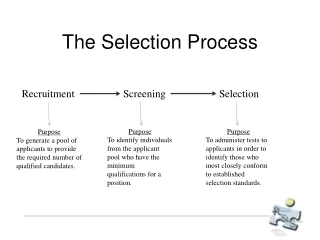
Learning Objectives 9 and 10 Steps in the Selection Process • SELECTION PROCESS STEPS • Recruitment/application • Written examination • Skills test • Oral examination/interview • Physical agility/ability • Cont.
Learning Objectives 9 and 10 Steps in the Selection Process • SELECTION PROCESS STEPS • Background check • Final oral exam • Medical examination • Probationary period • Last step in the selection process
Learning Objective 11 Purpose and Importance of Probationary Period • PROBATIONARY PERIOD • Academy program can be part of probationary period • After academy, firefighter goes to assignment at station • May last up to 12 months
Learning Objective 11 Purpose and Importance of Probationary Period • PROBATIONARY FIREFIGHTERS • Expected to perform independent study • May not have full civil service protection • May be removed if unable to perform duties • May be a comprehensive combination written/manipulative test at end of probation
Learning Objective 12 Steps in Setting SMART Goals • SETTING GOALS • Clearly define the goals • Create a road map to success • GOAL SETTING WITH SMART • Simple • Measurable • Accountable • Realistic • Timely
Summary • Process of becoming a firefighter starts by seeking an education in the fire science field • Prospective firefighter must prepare for all areas of the selection process • Be properly prepared for all phases