Download
1 / 20
200 likes | 326 Vues
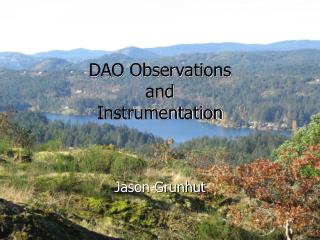
The Dominion Astrophysical Observatory, located atop Observatory Hill in Victoria, BC, boasts dark skies ideal for astrophysical research. Equipped with a 1.85 m Plaskett telescope and a 1.22 m McKeller telescope, it primarily focuses on spectroscopy with advanced automatic pointing. The observatory features a unique polarimeter designed by Dmitry Monin, utilizing achromatic quarter-wave plates and ferroelectric liquid crystal technology to capture and analyze light with high precision. This facility provides critical insights into stellar phenomena and instrumental effects.

E N D
DAO Observations and Instrumentation Jason Grunhut
Introduction to theDominion astrophysical Observatory • Situated on the peak of Observatory Hill in Victoria on Vancouver Island, British Columbia. • 19th mag dark skies • Two telescopes available • 1.85 m Plaskett • f/18 Cassegrain focus • f/5 modified Newtonian focus • Primarily used for spectroscopy • fully automatic pointing and guiding • 1.22 m McKeller telescope • Primarily used with Coudé focus. • Used for both spectroscopy and photometry
The Polarimeter • designed and built by Dmitry Monin • made from commercially available products • cheap • installed immediately after spectrograph slit. • achromatic quarter-wave plate converts light into two orthogonal linear polarizations (vertical/horizontal). • Ferroelectric Liquid Crystal (FLC) acts as half-wave plate • voltage controlled • near instantaneous change (few ns). • Calcite beam-displacer use to form image on CCD.
The Polarimeter - Continued • Take many spectra in two orthogonal states to remove instrumental effects. • Best at several Hz level • Usually use about 50-60 shifts. • Record both orthogonal states simultaneously.
CCD Image • Cover 4750-5000 Å • 0.15 Å/pixel dispersion • Resolving power of ~10 000 • ~70 G accuracy for 6th magnitude star in about 20 minutes (emission line star) using Fourier cross-correlation
Reductions • Reduced and extracted using IRAF • Correct for bias and bad pixels • Each beam is extracted separately • Matching beams are then combined • Single wavelength calibration is then applied • Stokes V is simply calculated from the difference of the two spectra (no prior normalization) • Resulting Stokes V and I spectra are normalized.
Issues and Future • Spurious detections in null-field standard stars. • Procyon, Theta Cep, Sigma And • Likely due to poor guiding in Declination. • Possibly due to poor alignment of crystal. • Improved since first tests. • Regression routine not entirely suitable as lines are well resolved. • Use Fourier Cross-Correlation • Use LSD method