
SlideServe
Menu
Préférences
© SlideServe · v2026

The nervous system’s two parts work together.

jelani-underwood avatar
7 diapositives · 189 Views · Nov 14, 2014

The nervous system comprises the central nervous system (CNS) and the peripheral nervous system (PNS), which work in tandem to interpret and transmit information. The CNS consists of the brain, brain stem, and spinal cord. It processes impulses received from the sensory neurons via the PNS and responds accordingly. The brain has three main parts: the cerebrum for thoughts and movement, the cerebellum for balance, and the brain stem for essential life functions. The PNS connects the CNS to muscles and organs, managing both voluntary and involuntary actions.
The nervous system’s two parts work together. - slide 1
01 / 7The nervous system’s two parts work together.
1 / 17

Télécharger la présentation

The nervous system’s two parts work together.
Une image / un lien ci-dessous est fourni (tel quel) pour télécharger la présentation

Politique de téléchargement : le contenu du site vous est fourni TEL QUEL pour votre information et votre usage personnel ; il ne peut être vendu, concédé sous licence ni partagé sur d’autres sites sans l’accord de son auteur.Le contenu vous est fourni TEL QUEL, pour votre information et votre usage personnel uniquement. Téléchargez la présentation en cliquant sur ce lien. Lors du téléchargement, si vous ne parvenez pas à télécharger une présentation, l’éditeur a peut-être supprimé le fichier de son serveur.Pendant le téléchargement, si vous ne parvenez pas à obtenir une présentation, le fichier a peut-être été supprimé par l’éditeur.

F I N

Plus de contenu associé

Transcription de la présentation
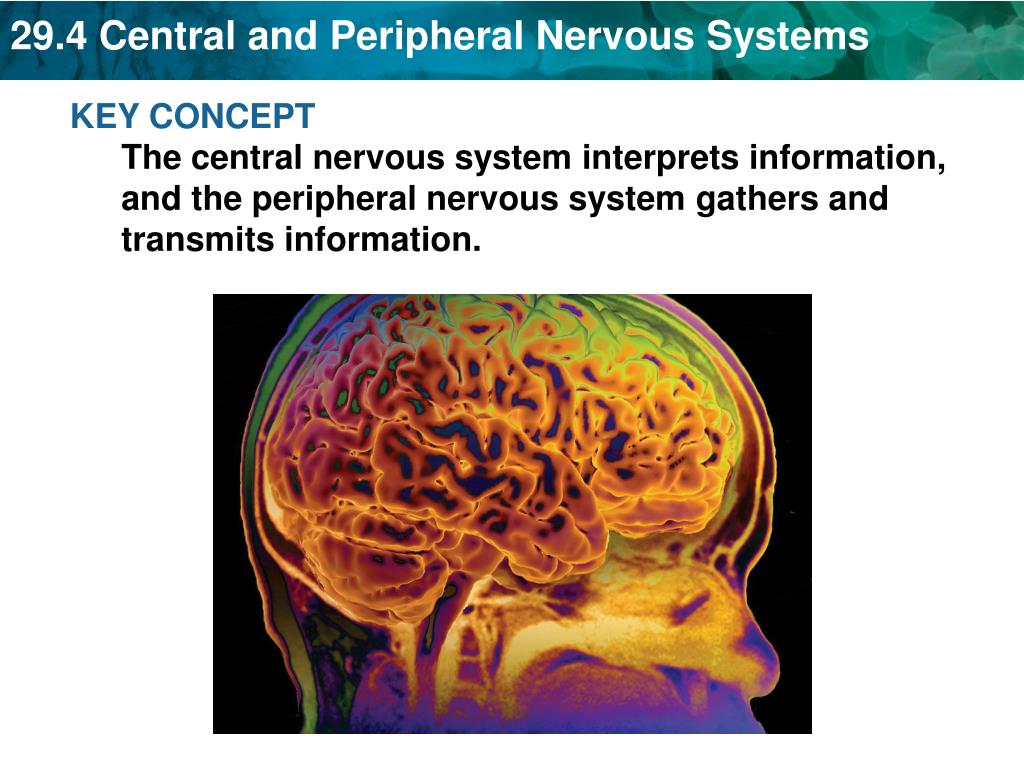
  1. KEY CONCEPT The central nervous system interprets information, and the peripheral nervous system gathers and transmits information.

  2. The nervous system’s two parts work together. • The CNS includes the brain, brain stem, and spinal cord. • The PNS includes four systems of nerves.

  3. PNS stimulates a response. • PNS passes impulse to CNS. • CNS interprets impulse. • CNS passes impulse to PNS. • Sensory receptor generates impulse • The CNS and PNS pass signals between one another.

  4. midbrain Brainstem pons medulla oblongata The CNS processes information. • The brain has three parts. • cerebrum controls thought, movement, emotion • Details: is biggest part of brain, what you think of when you see a brain • cerebellum allows for balance • Details: at base of brain, looks like cauliflower • brain stem controls basic life functions • Details: has midbrain, pons and medulla at top of spinal cord

  5. midbrain pons medulla oblongata • midbrain controls some reflexes • pons regulates breathing • medulla oblongata controls heart function, swallowing, coughing • The brain stem has three parts.

  6. interneuron motor neurons sensory neuron • sensory neuron sends impulse to spinal cord • spinal cord directs impulse to motor neuron • does not involve the brain • The spinal cord controls reflexes.

  7. The PNS links the CNS to muscles and other organs. • 1. The somatic nervous system regulates voluntary movements • Details: your moving and motor neurons • 2. autonomic nervous system controls involuntary, functions Details: breaks into sympathetic/parasympathetic • 3. sympathetic nervous system: “fight vs. flight” • -Details: adrenal gland • 4. parasympathetic nervous system: calms the body, • -Details: conserves energy , body at rest…