
SlideServe
Menu
Préférences
© SlideServe · v2026

Tentative mapping

jerij avatar
10 diapositives · 138 Views · Jan 06, 2020

This paper explores the integration of OGMS ontology into clinical archetypes, detailing mappings, translation, and enrichment. The study presents mapping approaches, including AM-OGMS, defining OGMS as part of the Reference Model, and creating a Disease layer. It also discusses the benefits of translating from ADL to OWL for coherence checks and navigability. The research suggests improving the Archetype Model to avoid concept overlapping and addresses ambiguities in existing archetypes.
Tentative mapping - slide 1
01 / 10Tentative mapping
1 / 17

Télécharger la présentation

Tentative mapping
Une image / un lien ci-dessous est fourni (tel quel) pour télécharger la présentation

Politique de téléchargement : le contenu du site vous est fourni TEL QUEL pour votre information et votre usage personnel ; il ne peut être vendu, concédé sous licence ni partagé sur d’autres sites sans l’accord de son auteur.Le contenu vous est fourni TEL QUEL, pour votre information et votre usage personnel uniquement. Téléchargez la présentation en cliquant sur ce lien. Lors du téléchargement, si vous ne parvenez pas à télécharger une présentation, l’éditeur a peut-être supprimé le fichier de son serveur.Pendant le téléchargement, si vous ne parvenez pas à obtenir une présentation, le fichier a peut-être été supprimé par l’éditeur.

F I N

Plus de contenu associé

Transcription de la présentation
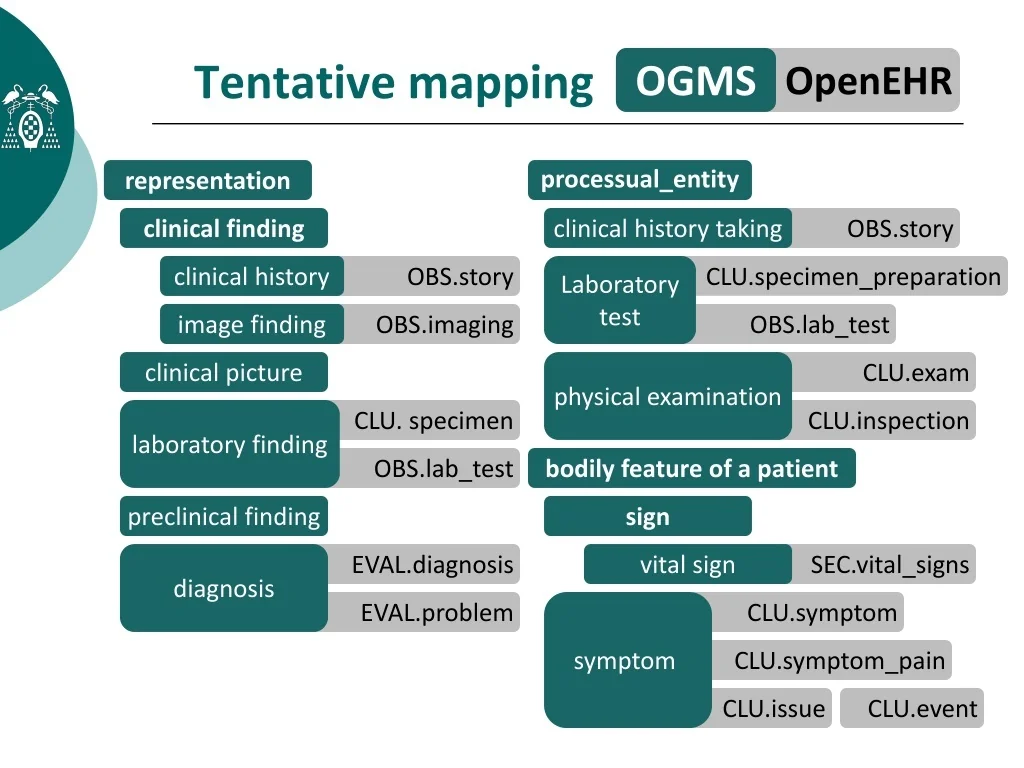
  1. Tentative mapping OGMS OpenEHR representation processual_entity clinical finding clinical history taking OBS.story clinical history OBS.story Laboratory test CLU.specimen_preparation image finding OBS.imaging OBS.lab_test clinical picture physical examination CLU.exam laboratory finding CLU. specimen CLU.inspection OBS.lab_test bodily feature of a patient preclinical finding sign diagnosis EVAL.diagnosis vital sign SEC.vital_signs EVAL.problem symptom CLU.symptom CLU.symptom_pain CLU.issue CLU.event

  2. OGMS integration approaches 1. OGMS - AM mappings (ambiguity, incompleteness) 2. Including OGMS terms as RM classes 3. Defining a new AM layer RM AM Pulse Medication order OGMS OpenEHR Disease core AM Particular archetypes Body Temperature Blood Pressure Pregnancy

  3. Translation from ADL to OWL archetypedefinition Observation data Event Series events Event_T data data Nortonscale data events Item List items Event Series events Element data Status transition data items List items Terminology General Physical Status

  4. Ontology bindings The term_binding section stores bindings between a particular term within the archetype and an equivalent concept in an ontology

  5. Equivalence relations Blood Pressure Arquetype Physiology ontology By linking the classes through a Necesary & Suficient condition we allow a reasoner to check data correctness and data coherence while preserves the ontology modularity during its exploitation.

  6. Enriched archetypes The Systolic pressure concept, defined in the archetype, is enriched with properties and attributes from the equivalent class within the Physiology ontology

  7. Workflow(Translation+ Mapping + Inference) Inference SNOMED Reference Model Archetype Ontologizer 1 3 ADL Archetype 2 Instance Mapper pat. data risk data data_norton_20080314.mdb data_norton_20080314_result.mdb

  8. Currently a module within the OpenEHR Java Reference Implementation Project

  9. Conclusions • The Archetype Model should be improved in order to prevent concept overlapping. • Existing archetypes cover several concepts of the OGMS ontology, although some ambiguities have been revealed. • Three mapping approaches were presented for the integration of the OGMS ontology : • AM – OGMS, direct mapping. • Definition of the OGMS as a part of the Reference Model • Creation of a Disease layer between the RM and the AM • The translation from ADL to OWL offers several advantages for reusability, coherence checks and navigability between archetypes and clinical ontologies.