
SlideServe
Menu
Préférences
© SlideServe · v2026

Overview on RBIR-based PHY Abstraction

jerold avatar
13 diapositives · 340 Views · Aug 05, 2014

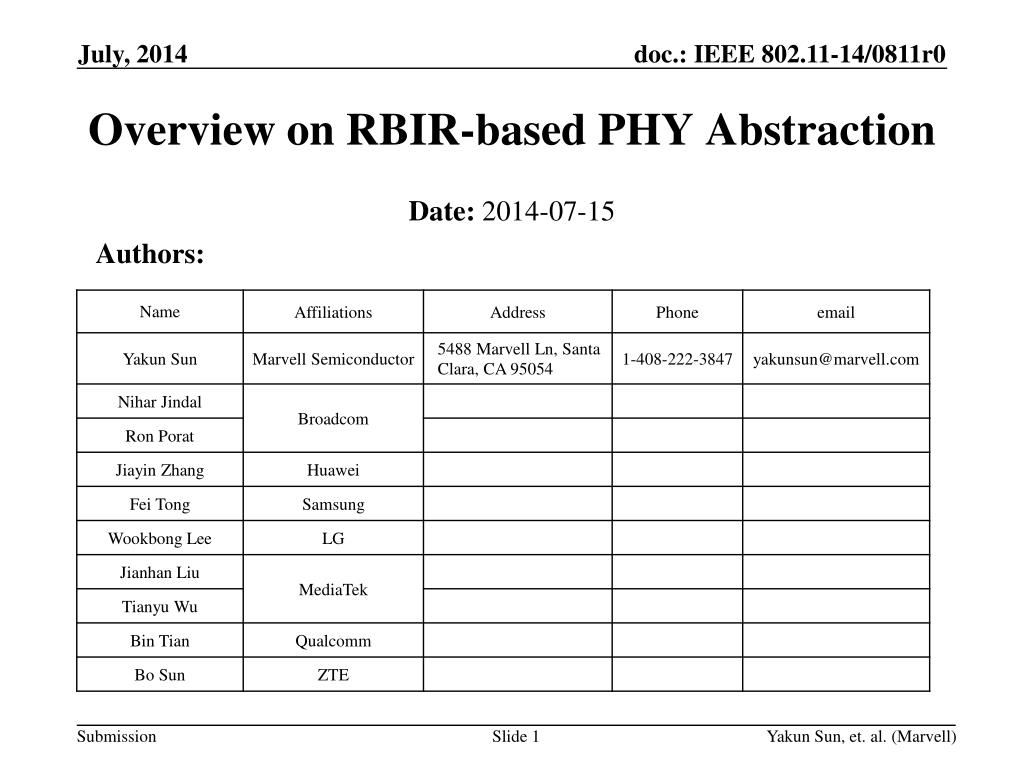
Overview on RBIR-based PHY Abstraction. Date: 2014-07-15. Authors:. Introduction. Received Bit Mutual Information Rate (RBIR) ESM has been well studied for PHY abstraction [ 1-10]. It has been agreed to use RBIR ESM as PHY abstraction for PHY and integrated system simulation [ 11].
Overview on RBIR-based PHY Abstraction - slide 1
01 / 13Overview on RBIR-based PHY Abstraction
1 / 17

Télécharger la présentation

Overview on RBIR-based PHY Abstraction
Une image / un lien ci-dessous est fourni (tel quel) pour télécharger la présentation

Politique de téléchargement : le contenu du site vous est fourni TEL QUEL pour votre information et votre usage personnel ; il ne peut être vendu, concédé sous licence ni partagé sur d’autres sites sans l’accord de son auteur.Le contenu vous est fourni TEL QUEL, pour votre information et votre usage personnel uniquement. Téléchargez la présentation en cliquant sur ce lien. Lors du téléchargement, si vous ne parvenez pas à télécharger une présentation, l’éditeur a peut-être supprimé le fichier de son serveur.Pendant le téléchargement, si vous ne parvenez pas à obtenir une présentation, le fichier a peut-être été supprimé par l’éditeur.

F I N

Plus de contenu associé

Transcription de la présentation
  1. Overview on RBIR-based PHY Abstraction Date: 2014-07-15 Authors: Yakun Sun, et. al. (Marvell)

  2. Introduction • Received Bit Mutual Information Rate (RBIR) ESM has been well studied for PHY abstraction [1-10]. • It has been agreed to use RBIR ESM as PHY abstraction for PHY and integrated system simulation [11]. • The current EMD [12] needs updates to provide RBIR PHY abstraction procedure and lookup tables. • An overview on RBIR PHY abstraction is presented here (also included the RBIR lookup tables). Yakun Sun, et. al. (Marvell)

  3. RBIR ESM Function • RBIR ESM is the symbol level mutual information conditioned on the M-QAM. • ESM function is defined as (given the SINR for a tone) • Assuming coded modulation (CM) where U is a zero mean complex Gaussian random variable with variance 1, i.e., U~CN(0,1). • RBIR is the average symbol level mutual information for a transmission of Nss spatial streams over N tones and T OFDM symbols. Yakun Sun, et. al. (Marvell)

  4. Procedure of RBIR PHY Abstraction • RBIR PHY abstraction is done by: • Step 1: Generate (both desired and interfering) channels. • Step 2: Calculate the equalizer-output SINR per spatial stream for the n-th tone/t-th OFDM symbol, SINR(iss,n,t), iss=1…Nss. • Equalizer is MRC if Nss=1, or MMSE if Nss>1. • Step 3: Map N×T×NssSINRs to 1 RBIR • Step 4: Reverse map 1 RBIR to 1 effective SNR Yakun Sun, et. al. (Marvell)

  5. Procedure of RBIR PHY Abstraction (2) • Step 5: Estimate the PER for this transmission • Selection of reference packet length is defined in [10]. • Step 6: Determine if this transmission is successfully received based on PER. Yakun Sun, et. al. (Marvell)

  6. Procedure of RBIR PHY Abstraction (3) • Step-by-step diagram of PHY abstraction (except for channel generation). • Step 1-2 are more time-consuming and can be simplified; step 3-5 are very efficient. • Note SINR per-OFDM symbol is calculated even for slow-fading channels if interference levels change across the duration of the transmission. Yakun Sun, et. al. (Marvell)

  7. Lookup Table for RBIR ESM • Real-time calculation of RBIR mapping (Φ function) is time consuming. • RBIR LUT can be used in this place for quick implementation. • 1 LUT for each modulation  5 LUTs for all current defined modulations. • For a PHY packet with a fixed MCS, only 1 LUT is loaded for PHY abstraction (PER prediction). Yakun Sun, et. al. (Marvell)

  8. RBIR PHY Abstraction Using LUT Yakun Sun, et. al. (Marvell)

  9. Link Adaptation Using LUT • Channel-aware link adaptation can also use RBIR-based PER prediction. • Iterate over all MCS to predict performance for each MCS via RBIR. • For example, genie max-rate link adaptation: • Suppose the SINR for each tone and each OFDM symbol is known. • For mcs = 0 to 9 • Step 1: Map SINRs into SNReff for the corresponding modulation • 1 out of 5 RBIR LUTs each iteration • Step 2: Predict PER based on SNRefffor the corresponding MCS • 1 out of 10 PER LUTs each iteration • Step 3: R(mcs) = (1-PER) * rate(mcs) • Select MCS* = argmax_{mcs=0…9} R(mcs) Yakun Sun, et. al. (Marvell)

  10. What is Needed in EMD for RBIR? • LUT for RBIR ESM mapping and AWGN PER. • 5 RBIR LUTs • 10 PER LUTs for BCC/LDPC respectively for each reference packet length. • LUTs are provided in [14]. Yakun Sun, et. al. (Marvell)

  11. Further Works • Impact of implementation loss • Channel estimation error (e.g., [5,13]) • Impact of excessive long channels for outdoor scenarios (ISI/ICI) • Other practical impairments (CFO/timing/PN…) Yakun Sun, et. al. (Marvell)

  12. Straw Poll • Include the procedure of PHY abstraction in slide3-4 into EMD • Y: • N: • A: Yakun Sun, et. al. (Marvell)

  13. References • IEEE 802.16m-08/004r5, “IEEE 802.16m Evaluation Methodology Document” • 3GPP TR 25.892 V2.0.0 “Feasibility Study for OFDM for UTRAN enhancement”, June 2004. • 11-14-0117-00-0hew-PHY-abstraction-for-HEW-system-level-simulation • 11-13-1131-00-0hew-phyabstraction-for-hew-system-level-simulation • 11-14-0353-00-0hew-suggestion-on-phy-abstraction-for-evaluation-methodology • 11-14-0043-02-0hew-PHY-abstraction-in-system-level-simulation-for-HEW-study • 11-14-0335-00-0hew-instantenous-sinr-calibration-for-system-simulation • 11-14-0581-00-00ax-further-discussion-on-phy-abstraction • 11-14-0647-02-00ax-phy-abstraction-comparison • 11-14-0803-01-00ax-Packet-Length-for-Box-0-Calibration • 11-14-0585-05-00ax-phy-abstraction-types-for-11ax-system-level-simulation • 11-14-0571-02-00ax-evaluation-methodology • 11-14-0810-00-00ax-RBIR-based-phy-abstraction-with-channel-estimation-error • 11-14-873-00-00ax-PHY-Abstraction-Tables-for-11ax-System-Level-Simulation Yakun Sun, et. al. (Marvell)