Understanding Order Statistics and Their Distributions in Probability Theory
200 likes | 324 Vues
This overview delves into order statistics, focusing on the distribution of order variables and extremes from random samples. Definitions of order statistics are explored, along with examples illustrating their probabilities, such as the maximum in a uniform distribution and the median in a finite population. We also examine the beta distribution in context with extremes and arbitrary order variables, along with joint distributions and transformation functions of random variables. Essential for statistical analysis, this material underlines the interplay of order statistics and probability theory.


Understanding Order Statistics and Their Distributions in Probability Theory
E N D
Presentation Transcript
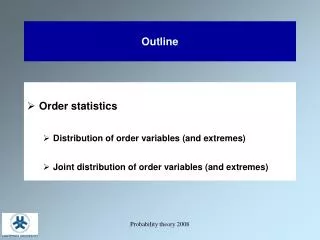
Outline • Order statistics • Distribution of order variables (and extremes) • Joint distribution of order variables (and extremes) Probability theory 2008
Order statistics Let X1, …, Xnbe a (random) sample and set X(k) = the kth smallest ofX1, …, Xn Then the ordered sample (X(1), X(2), …, X(n)) is called the order statistic of (X1, …, Xn) and X(k)the kth order variable Probability theory 2008
Order variables - examples Example 1: Let X1, …, Xnbe U(0,1) random numbers. Find the probability that max(X1, …, Xn) > 1 – 1/n Example 2: Let X1, …, X100 be a simple random sample from a (finite) population with median m. Find the probability that X(40) > m. Probability theory 2008
Distribution of the extreme order variables Probability theory 2008
The beta distribution For integer-valued r and s, the beta distribution represents the rth highest of a sample of r+s-1 independent random variables uniformly distributed on (0,1) =r =s Probability theory 2008
The gamma function Probability theory 2008
Distribution of arbitrary order variables Probability theory 2008
A useful identity Can be proven by backward induction Probability theory 2008
Distribution of arbitrary order variables Probability theory 2008
Distribution of arbitrary order variablesfrom a U(0,1) distribution Probability theory 2008
Joint distribution of the extreme order variables Probability theory 2008
Functions of random variables Let X have an arbitrary continuous distribution, and suppose that g is a (differentiable) strictly increasing function. Set Then and
Linear functions of random vectors Let (X1, X2) have a uniform distribution on D = {(x , y); 0 < x <1, 0 < y <1} Set Then .
Functions of random vectors Let (X1, X2) have an arbitrary continuous distribution, and suppose that g is a (differentiable) one-to-one transformation. Set Then where h is the inverse of g. Proof: Use the variable transformation theorem
Density of the range Consider the bivariate injection Then and Probability theory 2008
Density of the range Probability theory 2008
The range of a sample from an exponential distribution with mean one Probabilistic interpretation of the last equation? Probability theory 2008
Joint distribution of the order statistic Consider the mapping (X1, …, Xn) (X(1), …, X(n)) or . where P is a permutation matrix Probability theory 2008
Joint density of the order statistic Probability theory 2008
Exercises: Chapter IV 4.2, 4.7, 4.9, 4.12, 4.14, 4.17 Probability theory 2008