Exploring Ancient Feasts and Family Dynamics: Understanding Our Ancestors
120 likes | 232 Vues
In this unit, we delve into the significance of feasts from 18,000 BC, examining key terms like "reunion" and "feast." We learn about the food prepared by Lala’s family, including nuts, fruit, and meat, while exploring statements about family groups and tool-making. The discussion extends to gender roles in ancient societies, challenging the notion that women should only care for the family. Students are encouraged to research their ancestors for a future presentation, fostering a deeper appreciation of our heritage.


Exploring Ancient Feasts and Family Dynamics: Understanding Our Ancestors
E N D
Presentation Transcript
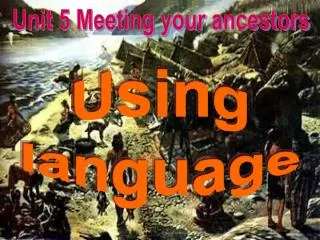
Unit 5 Meeting your ancestors Using language
Reading THE FEAST: 18, 000 BC
feast, , reunion , wrinkle, applaud, look ahead , accelerate one’s walk arrest one’s progress, dizzy, pronounced, arrowhead ,scrape
Scanning What kind of food did Lala’s family prepare for the feast? Nuts, fruit, fish, the deer and pig meat.
Skimming Please decide whether the statements are true or false. 1. Lala’s family groups usually lived together. 2. Dahu was good at making tools. 3. The family groups lived on hunting. 4. Dahu went out to sharpen the scrapers to kill an enemy. F separately _______ T T F scrape the fish ___________
caring , tough, protective, dangerous, safe , useful , co-operative, patient , individual , exhausting , skilful
Discussion and writing Some people say: “It is women that should stay at home and take care of the family.” Do you agree or not? The following expressions may help you. In my opinion,… I (don’t) agree because… I support … because … No, I can’t agree with …because… No, that’s not reasonable because…
Homework Surf the internet to find out more information about our ancestors and get prepared to make a public report in tomorrow’s class, OK?