The Sun: Our Star's Structure, Energy Production, and Solar Phenomena
The Sun is a typical star that generates energy through nuclear fusion, primarily converting hydrogen into helium. This process occurs in its core, where 4 million tons of hydrogen are transformed into energy every second. The Sun's structure includes three main zones: the core, radiation zone, and convection zone. It has a multi-layered atmosphere comprising the photosphere, chromosphere, and corona. Solar phenomena, such as sunspots, prominences, and solar flares, impact space weather. With approximately 10 billion years of fuel left, the Sun will eventually grow and affect the Earth.

The Sun: Our Star's Structure, Energy Production, and Solar Phenomena
E N D
Presentation Transcript
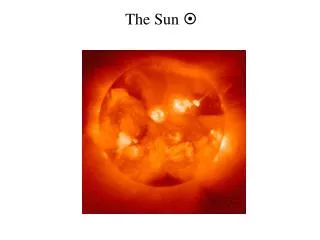
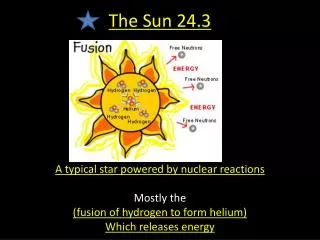
The Sun 24.3 A typical star powered by nuclear reactions Mostly the (fusion of hydrogen to form helium) Which releases energy
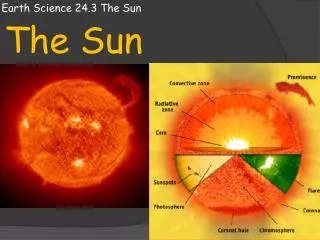
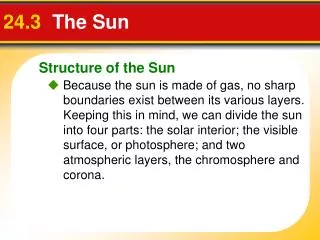
Structure of the sun • Solar Atmosphere • Solar interior (core)
Solar Interior b) Radiation Zone – energy moves outward as electromagnetic radiation • Core - Where nuclear fusion of hydrogen into helium occurs c) Convection Zone – Area of convection where energy is being transferred away from the core
The Sun’s interior • The sun produces energy by nuclear fusion • During nuclear fusion • 4 hydrogen(4.032 atomic mass, 4 X 1.008) are changed (converted) into 1 helium (4.003 atomic mass) • Energy is released– tiny missing mass is converted into energy according to Einstein’s equation
The Sun’s interior cont… • each second • Sun consumes ~ 600 million tons of hydrogen • Converting ~ 4 million tons into energy • As hydrogen is consumed, helium is produced forming the solar core • Core is continually growing in size • ~ 100 billion years of fuel left • The sun will remain it’s currents size ~ 10 billion years before it grows in size and eventually consumes Earth
Solar atmosphere Photosphere • Layer of gas and is the visible surface of the sun • ~ 90% hydrogen • ~ 10% helium • 500 kilometers thick • Appearance of boiling with up and down movements of gas • convection of gas transfers energy • Tiny amounts of other elements
c) Corona b) Chromosphere • Outermost layer of the solar atmosphere with low density • layer of ionized gases • produce solar winds as protons and electrons escape from the gravity of the sun • Thin red layer of hot gases under low pressure • Few thousand kilometers thick • Found above the photosphere
sunspots • Dark areas on the surface of the photosphere • Areas with temperatures less than surrounding area • # of sunspots varies in an 11 year cycle
Prominences Solar Flares • Huge cloudlike arches of gases • Explosive outbursts of sudden brightening above sunspot clusters • Release high amounts of solar energy • Ultraviolet • Radio • X-ray